
From DowJo — where this research becomes practice. Train your judgment before you risk your money.
Course Research · Episode 4
AI Is Not a Chip Trade
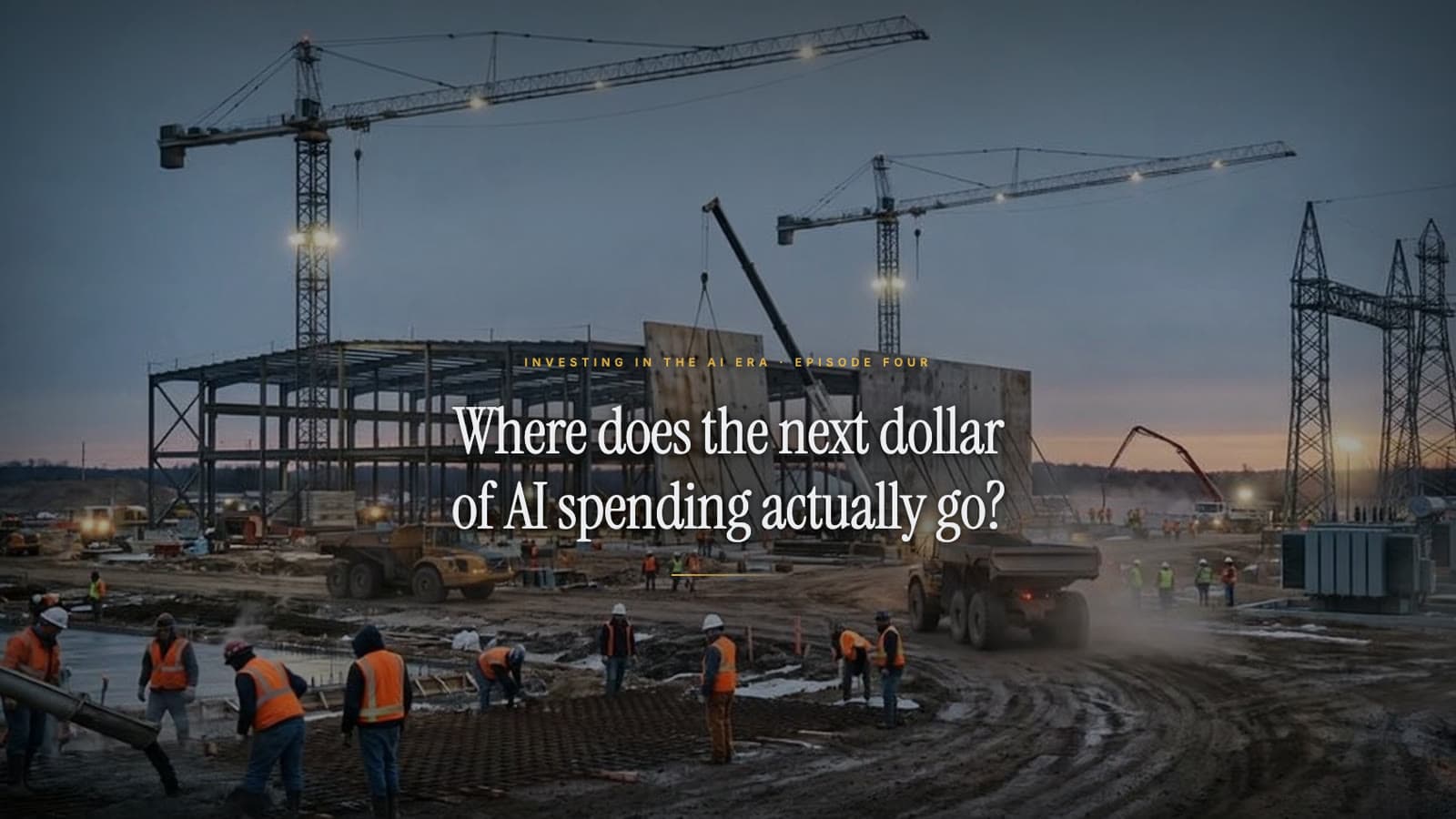
Where does the next dollar of AI spending actually go?
The evidence-led takeaway
A dollar of AI spending does not stop at a chip. It travels through a physical system — assemblers, memory, foundries, packaging, optics, buildings, cooling, substations, turbines, copper — and at every station somebody is paid a different amount for a different reason.
 Ask Jo about this research
Jo reads this note before answering. Sign in to ask Jo with this evidence attached — you come straight back here.
In brief
What this research concludes
A dollar of AI spending does not stop at a chip. It travels through a physical system — assemblers, memory, foundries, packaging, optics, buildings, cooling, substations, turbines, copper — and at every station somebody is paid a different amount for a different reason. The question worth asking is not which layer is the AI layer. It is where demand meets something that cannot be built quickly, and whether the company standing there can actually charge for it.
The judgment skill this hands over
Follow the money to the constraint, then ask the two questions the constraint does not answer by itself: how long does it take to add supply here, and can this supplier actually raise its price?
What we investigated
Where does the next dollar of AI spending actually go?
This is episode 4 of Investing in the AI Era, a 14-episode course. The film tells the story; this note is the research behind it, kept inspectable.
The research question the team set itself: How do you show that a dollar of AI spending is a system rather than a stock, without re-running Episode 1's descent and without stealing Episodes 5, 6 and 12's lessons?
Who and what this looks at
How we tested it
Researched to be refuted, not confirmed
Candidate claims went to an independent pass instructed to refute them against primary sources. Survivors became evidence; casualties became the refused list below.
The method, in the research team's own words
Eleven independent research lenses (who-pays-whom, accelerators, memory, foundry and equipment, networking and optics, servers and data centres, power and grid, margin structure, adversarial, historical analogues, constraint mechanics, frontier window) run in parallel, each returning candidate claims with primary sources. Every claim was then sent in batches to an independent fact-checker instructed to REFUTE it against the primary source itself rather than to confirm it, and to default to UNSUPPORTED when it could not verify. Survivors and corrected survivors enter narratable_facts; the corrected sentence is what the episode may narrate. Numeric series that go on screen were compiled separately and directly from SEC XBRL company facts rather than quoted from prose. Sixty-six agents ran with zero failures across eleven lenses, three numeric-series compilations and their adversarial verifiers; 227 candidate claims were proposed and every one was sent for refutation. The numeric series that go on screen were compiled directly from SEC XBRL company facts by a separate pass rather than quoted from any lens's prose.
What was screened before the case was chosen · 5 candidates
A map that pulls backward from the picture the learner arrived with
SELECTED as the spine. Episode 1 already taught the chain as a DESCENT — a vertical list of ten layers arriving one row at a time — and running that component again over the same layers would have made this a longer version of a scene the founder has already approved. A descent is a list and a list has no outside; a map does, and the outside is the whole episode. The three cards the learner carries become a corner of a sixteen-station machine, and the confident arrow from the model to the chip dissolves because two stations were hiding inside it.
A who-pays-whom flow diagram: hyperscaler capex into named suppliers' revenue
REJECTED and recorded as packet exclusion X02. It was the plan. The flows are not matched transactions — different periods, other customers, no disclosed correspondence, and a large share of capex is land, shell and construction that never reaches a named public supplier. Drawing it would have asserted a precision no filing supports. The film shows the money on one side and each layer’s own reported economics on the other, and never draws an arrow between two numbers it cannot join.
A gross-margin ladder ACROSS the chain, accelerators to assemblers
REJECTED as the margin scene, because it is Episode 1’s scene. Research found something narrower and sharper: five filers INSIDE networking alone, quarters ending within 58 days of each other, all five growing revenue, all five calling it AI demand, and GAAP gross margin descending from 69.5% to 12.0%. Everyone on that list is an AI networking company, which is what makes it a turn rather than a recap.
Naming today’s bottleneck and following it
REJECTED. Bottleneck economics is Episode 5’s lesson, and naming a binding constraint as a property rather than a moment is the error this episode exists to prevent. The film teaches the QUESTION — where is the constraint, how long does supply take to add, and can the supplier charge — and lets the buyers’ own filings say where the money actually went.
The 1996-2002 fibre buildout as a counter-case
RESEARCHED AND CUT FOR SCOPE. The material is strong and it is in the packet, but the episode already carries its own adversarial spine — a monopolist earning less than its customer’s customer, four filed cases of revenue up and margin flat or down, and a memory layer that lost money for a full year three years ago. Adding a historical bubble analogy would have pulled the film toward Episode 12’s territory in its final act.
What the evidence says
31 claims survived refutation
Each carries its source, the date the thing happened and the date it was said — two different facts — and its limits, stated by the research team rather than left for you to discover.
- FactFrontier · Aug 2026Primary sourceF01
Microsoft, Alphabet, Amazon and Meta together reported about $69.4 billion of capital expenditure in their fiscal years ending in 2019, and about $357.5 billion in their fiscal years ending in 2025 — a 5.1x increase over six years.
Published 6 Feb 2026
Basis: US GAAP as-reported cash-flow line item, USD, each company's own fiscal year
Limits: Microsoft's fiscal year ends 30 June; the other three end 31 December, so the 2019 and 2025 columns each combine one twelve-month period offset by six months from the other three. The chart states this. Amazon tags the same economic line under a different us-gaap concept, and the concept used for each filer is printed in the source note.
Research note
Falsifier: Alphabet, Amazon and Meta report fiscal 2026 in late January / early February 2027, which supersedes the last column.
- FactFrontier · Aug 2026Primary sourceF02
Microsoft's capital expenditure in the fiscal year ended 30 June 2026 was $115.948 billion under the cash-flow line item 'Additions to property and equipment' — about two thirds more than the four companies spent between them in 2019.
Published 30 Jul 2026
Basis: US GAAP as-reported, USD, fiscal year to 30 June 2026
Limits: Microsoft separately describes a higher 'capital expenditure including finance leases' figure in its commentary. This is the filed cash-flow concept, and the two are not blended.
- FactFrontier · Aug 2026Primary sourceF03
For calendar 2026, Microsoft has guided to approximately $175 billion of capital expenditure, revised down from approximately $190 billion for an accounting reason unrelated to component prices; Alphabet has guided to $195-205 billion, raised on 22 July 2026 from a prior $180-190 billion; and Amazon expects approximately $220 billion of cash capital expenditure, raised on 30 July 2026 from approximately $200 billion. Meta declined to give a 2027 capital-expenditure outlook.
Published 30 Jul 2026
Basis: Company guidance, calendar 2026, stated on earnings calls; not an audited figure
Limits: Guidance, not a filed result. Each company's definition of capital expenditure differs slightly; Amazon's is 'cash capital expenditure'.
Research note
Falsifier: the next quarterly earnings call from any of the four, expected late October 2026.
- FactFrontier · Aug 2026Primary sourceF04
In the quarter ended 30 June 2026 Alphabet's capital expenditure of $44.924 billion exceeded its operating cash flow of $39.069 billion, producing negative free cash flow of $5.855 billion for the quarter.
Source: Alphabet Inc. Form 10-Q for the quarter ended 30 June 2026 (opens abc.xyz)
Published 22 Jul 2026
Basis: US GAAP as-reported, USD
- FactFrontier · Aug 2026Primary sourceF05
Across five filers whose most recently reported quarters ended within 58 days of each other, GAAP as-reported gross margin descends in step down the networking and optics stack: Broadcom 69.5% (quarter ended 3 May 2026), Arista 62.9% (30 June 2026), Lumentum 47.4% (27 June 2026), Coherent 38.5% (30 June 2026), Fabrinet 12.0% (26 June 2026).
Published 14 Aug 2026
Basis: GAAP as-reported gross margin for each filer's most recent quarter; several also publish higher non-GAAP figures, which are not used
Limits: Five companies at different points in one layer, not five companies doing the same thing. Broadcom's figure is consolidated and includes infrastructure software; Fabrinet is a contract manufacturer whose economics are structurally different by design. The comparison is of what each keeps, not of how hard each works.
- FactFrontier · Aug 2026Primary sourceF06
All five of those companies grew revenue year over year in those quarters — Broadcom +47.9%, Arista +37.7%, Lumentum +109.3%, Coherent +34%, Fabrinet +44.6% — and growth did not lift every margin: over the same year Arista's GAAP gross margin fell from 65.2% and Fabrinet's edged down from 12.2%, while Broadcom's, Lumentum's and Coherent's rose.
Source: Company quarterly results releases, same five filers (opens investors.arista.com)
Published 14 Aug 2026
Basis: GAAP as-reported, year-over-year, each company's own quarter
- FactPrimary sourceF07
Arista Networks lists 'our reliance upon a predominant merchant silicon vendor' among the risk factors in its own SEC filings.
Source: Arista Networks, Inc. Form 10-K risk factors (opens investors.arista.com)
Published 17 Feb 2026
Basis: The company's own filed risk-factor language
- FactFrontier · Aug 2026Primary sourceF08
NVIDIA reported GAAP gross margin of 75.0% for the quarter ended 26 July 2026 (Q2 fiscal 2027), on Data Center revenue of $89.023 billion.
Source: NVIDIA Corporation Form 8-K Exhibit 99.1, Q2 FY2027 results (opens investor.nvidia.com)
Published 26 Aug 2026
Basis: US GAAP as-reported; NVIDIA's fiscal year ends in late January, so fiscal Q2 2027 is the calendar quarter to 26 July 2026
Research note
Falsifier: NVIDIA's Q3 FY2027 report, expected November 2026.
Show the remaining 23 pieces of evidence
- FactFrontier · Aug 2026Primary sourceF09
ASML, the only manufacturer of extreme-ultraviolet lithography systems, reported a gross margin of 54.0% for the quarter ended in June 2026.
Source: ASML Holding N.V. Q2 2026 results (opens asml.com)
Published 15 Jul 2026
Basis: IFRS as-reported, EUR
Limits: ASML's monopoly is on EUV systems specifically, not on lithography as a whole; it competes in deep-ultraviolet. The comparison with NVIDIA is between two companies on different accounting standards and in different currencies, which does not affect a margin ratio but is stated on the frame.
- FactFrontier · Aug 2026Primary sourceF10
Super Micro's fiscal 2026 (year ended 30 June 2026) net sales were $39.063 billion, up 78% from $21.972 billion, while GAAP gross margin fell to 10.8% from 11.1%; in fiscal 2019 its gross margin was 14.2%.
Published 11 Aug 2026
Basis: US GAAP as-reported, most recently filed value for each period
Limits: Super Micro's filings for fiscal 2024 and 2025 were delayed and subsequently re-presented; the values used are the most recently filed version of each period, per the studio's filer-wins rule.
- FactFrontier · Aug 2026Primary sourceF11
Hon Hai Technology Group (Foxconn), the largest contract manufacturer of AI servers, reported a gross margin of 6.12% and an operating margin of 3.75% for the quarter ended 30 June 2026.
Source: Hon Hai Precision Industry Co., Ltd. Q2 2026 consolidated results (opens honhai.com)
Published 14 Aug 2026
Basis: Taiwan IFRS as-reported, NT$
- FactFrontier · Aug 2026Primary sourceF12
Fabrinet's fiscal 2026 (year ended 26 June 2026) revenue was $4.641 billion, up 36%, while GAAP gross margin was 12.0%, down from 12.2%.
Source: Fabrinet Form 8-K Exhibit 99.1, Q4 and FY2026 results (opens investor.fabrinet.com)
Published 17 Aug 2026
Basis: US GAAP as-reported, USD
- FactPrimary sourceF13
An NVIDIA GB300 NVL72 rack-scale system is specified by NVIDIA as a liquid-cooled rack of 72 GPUs requiring up to 142 kW.
Source: NVIDIA reference architecture documentation, GB300 NVL72 (opens docs.nvidia.com)
Published 1 Jun 2026
Basis: Vendor technical specification
Limits: A rated maximum for one specific product, not an average of deployed racks.
- FactFrontier · Aug 2026Primary sourceF14
Microsoft's chief financial officer told investors on 29 April 2026: 'For calendar year 2026, we expect to invest roughly $190 billion in capital expenditures which includes approximately $25 billion from the impact of higher component pricing.'
Source: Microsoft Fiscal Year 2026 Third Quarter Earnings Conference Call, Amy Hood (opens microsoft.com)
Event 29 Apr 2026 · Published 29 Apr 2026
Basis: Verbatim from the company's own earnings call, published on its investor-relations site
Limits: Microsoft did not say its equipment volumes were flat, and it later revised the $190 billion to approximately $175 billion for an accounting reason unrelated to component prices. Both qualifications are narrated.
- FactFrontier · Aug 2026Primary sourceF15
On 30 July 2026 Amazon's chief executive said the company now expects to spend approximately $220 billion in cash capital expenditure in 2026, up from a prior estimate of about $200 billion, attributing the increase to the higher cost of memory, and said that even at that amount 'we will still not have enough capacity to meet all the demand we have in 2026.'
Event 30 Jul 2026 · Published 30 Jul 2026
Basis: Company statement on an earnings call, corroborated by the filed 10-Q for the quarter
Limits: The memory attribution is the company's own explanation of its own number, not an independently established causal finding.
- FactFrontier · Aug 2026Primary sourceF16
SK hynix reported an operating margin of 76% for the quarter ended 30 June 2026 — its all-time high — and reported an operating LOSS of KRW 7.73 trillion for the full year 2023, an operating margin of roughly minus 24%.
Source: SK hynix quarterly and annual results releases (opens skhynix.com)
Published 23 Jul 2026
Basis: K-IFRS as-reported, KRW, company results releases
Limits: Two different period types — one quarter against one full year — and the comparison is used only to show that the same layer has produced both outcomes, never to imply a rate of change.
- FactFrontier · Aug 2026Primary sourceF17
Micron reported a GAAP gross margin of 84.6% for the quarter ended 28 May 2026, against 39.8% for the fiscal year ended 28 August 2025.
Source: Micron Technology, Inc. Form 8-K Exhibit 99.1 and Form 10-Q (opens investors.micron.com)
Published 24 Jun 2026
Basis: US GAAP as-reported, USD; Micron's own release headlines higher non-GAAP figures, which are not used
Limits: One quarter of an extreme pricing environment is not a durable margin structure, and the episode says so.
- FactFrontier · Aug 2026Primary sourceF18
NVIDIA disclosed that in the quarter ended 26 July 2026 one direct customer represented 16% of total revenue, and that for the first half three direct customers represented 16%, 15% and 13%.
Source: NVIDIA Corporation Form 10-Q for the period ended 26 July 2026 (opens investor.nvidia.com)
Published 26 Aug 2026
Basis: Required concentration disclosure; 'direct customer' means the party NVIDIA invoices, which is often not the end user of the hardware
Limits: A direct customer is frequently an OEM, ODM or system integrator rather than the ultimate operator, so this measures invoicing concentration rather than demand concentration.
- FactFrontier · Aug 2026Primary sourceF19
For fiscal year 2026, sales to a single customer represented 28.1% of Super Micro's total net sales.
Published 29 Aug 2026
Basis: Required concentration disclosure
- FactFrontier · Aug 2026Primary sourceF20
NVIDIA disclosed that its supply commitments increased from $119 billion at the end of the prior quarter to $279 billion as of 26 July 2026.
Source: NVIDIA Corporation Form 10-Q for the period ended 26 July 2026 (opens investor.nvidia.com)
Published 26 Aug 2026
Basis: Filed commitments disclosure
Limits: A commitment to purchase, not a forecast of revenue; it can be wrong in either direction.
- FactFrontier · Jun 2026ResearchF21
Lawrence Berkeley National Laboratory's 2026 'Queued Up' study finds that the median United States generation project reaching commercial operation in 2025 took 61 months from its interconnection request, up from 36 months for projects completed in 2015 and 22 months in 2005.
Source: Lawrence Berkeley National Laboratory, Queued Up (2026 edition) (opens emp.lbl.gov)
Published 1 Jun 2026
Basis: Agency-funded research using interconnection-queue records; medians across all queued generation, not data-centre-specific
Limits: This measures generation projects, not data centres, and a median hides a wide distribution.
- FactFrontier · Jul 2026Primary sourceF22
ERCOT reported tracking approximately 474 GW of large loads seeking interconnection as of June 2026, of which about 90% are data centres — and NERC documents that data-centre demand projections in Texas 'are reduced by almost 50% of their original requested load level to reflect the observed consumption behavior of existing data centers.'
Published 28 Jul 2026
Basis: Grid-operator and regulator reporting
Limits: An interconnection request is not a commitment to build, and the same projects are frequently counted in more than one queue. The 50% haircut is the regulator's own correction for exactly that.
- FactPrimary sourceF23
TSMC began high-volume production on its N4 process at its Arizona site in the fourth quarter of 2024, having announced the project in May 2020.
Source: TSMC investor communications and company announcements (opens investor.tsmc.com)
Published 1 Dec 2024
Basis: Company statements
Limits: One site, one company, one process node — an illustration of the order of magnitude, not an industry average.
- FactFrontier · Aug 2026Primary sourceF24
NVIDIA's fiscal 2026 revenue was $215.938 billion, up 65% year on year, while GAAP gross margin FELL 3.9 percentage points to 71.1% from 75.0%. The company attributes the decline to the transition from Hopper HGX systems to full-scale Blackwell datacenter solutions.
Source: NVIDIA Corporation Form 10-K for the fiscal year ended 25 January 2026 (opens sec.gov)
Published 25 Feb 2026
Basis: US GAAP as-reported, consolidated, USD. NVIDIA's fiscal year ends in late January, so fiscal 2026 is roughly calendar 2025.
Limits: A margin can fall for reasons that have nothing to do with pricing power, and the company gives one. The episode reports the fall and the company's own explanation, and draws no inference about pricing power from it.
- FactFrontier · Aug 2026Primary sourceF25
TSMC's chief executive said on the company's second-quarter 2026 earnings call that 'our packaging capacity is so tight that now it limits my customers' growth', and separately that developing a new process technology, building the capacity and ramping it 'now takes five to seven years. There are no shortcuts.'
Event 16 Jul 2026 · Published 16 Jul 2026
Basis: Verbatim from the company's own earnings call, published on its investor-relations site
Limits: One company's statement about its own capacity, not an industry measurement.
- FactFrontier · Aug 2026Primary sourceF26
Asked on the same call why TSMC is no longer the most profitable semiconductor manufacturer and what its pricing approach is, its chief executive answered that TSMC is a partner and its customers have to be successful — 'I don't want to squeeze them out from the market' — and that it does not suddenly raise prices by large multiples.
Event 16 Jul 2026 · Published 16 Jul 2026
Basis: Verbatim from the company's own earnings call
Limits: A statement of intent by an executive, not an audited pricing policy. It is narrated as what he said, not as a proven cause of the margin.
- FactFrontier · Aug 2026Primary sourceF27
CoreWeave's annual report states that approximately 67% of its 2025 revenue came from its top customer, Microsoft, named in the filing.
Source: CoreWeave, Inc. Form 10-K for the fiscal year ended 31 December 2025 (opens sec.gov)
Published 2 Mar 2026
Basis: Required customer-concentration disclosure
- FactFrontier · Aug 2026Primary sourceF28
NVIDIA disclosed that for fiscal year 2026 sales to one direct customer represented 22% of total revenue and sales to another direct customer represented 14%.
Source: NVIDIA Corporation Form 10-K for the fiscal year ended 25 January 2026 (opens sec.gov)
Published 25 Feb 2026
Basis: Required concentration disclosure. A 'direct customer' is the party NVIDIA invoices, frequently an OEM, ODM or integrator rather than the operator of the hardware.
Limits: Measures invoicing concentration, not end-demand concentration. The episode says so on the frame.
- FactFrontier · Aug 2026Primary sourceF29
Fabrinet's annual report discloses four customers each at 10% or more of revenue, totalling 57.4%: Cisco 19.9%, NVIDIA 16.3%, Nokia 10.7%, Amazon 10.5%. NVIDIA's share fell from 35.1% in fiscal 2024 and 27.6% in fiscal 2025, while total revenue rose 35.7% — so the falling percentage does not mean falling dollars.
Source: Fabrinet Form 10-K for the fiscal year ended 26 June 2026 (opens sec.gov)
Published 18 Aug 2026
Basis: Required concentration disclosure
- FactFrontier · Aug 2026Primary sourceF30
TIME TO ADD SUPPLY, eight layers, each from a primary or agency source. Another data-centre building on a campus that already has power: 12-23 months (TeraWulf's 401 MW lease at its Kentucky campus). A large power transformer, order to delivery: 18-48 months (Wood Mackenzie, quoted in an SEC-filed investor presentation; the US Department of Energy separately reports 36-month lead times commonly quoted and maxima reaching 60). A new advanced-packaging plant, construction start to first manufacturing: 24-42 months (Amkor, Arizona). A new US high-voltage transmission line, CONSTRUCTION ONLY: 24-48 months (US Department of Energy, Grid Deployment Office). A leading-edge logic fab, announcement to volume production: 54 months (TSMC Arizona — announced May 2020, N4 volume production Q4 2024). A new DRAM fab, groundbreaking to first wafer output: 45-63 months (Micron, Boise). A heavy-duty gas turbine plant, order to commercial operation at current backlogs: 36-84 months. A new copper mine, discovery to first production: 16-20 years (IEA, average of major mines that came online 2010-2019).
Published 31 Aug 2026
Basis: Each row states its two endpoints. Rows are comparable because each names the events it runs between, which is what the first draft of this chart got wrong.
Limits: Every row is a range and is drawn as one. The transmission-line row is construction only: no defensible planning-to-energisation figure for a new US high-voltage line could be established from a primary source, so that bar understates its own clock. It is labelled on the frame.
- Counter-argumentFrontier · Aug 2026Primary sourceF31
Microchip Technology's revenue for the fiscal year ended 31 March 2026 was $4.713 billion — up 7% year on year, but 44% BELOW its fiscal-2023 peak of $8.439 billion. Three years into the AI buildout, this semiconductor company's revenue is far below where it stood before it began.
Source: SEC XBRL company facts, Microchip Technology Inc., Forms 10-K FY2023-FY2026 (opens data.sec.gov)
Published 21 May 2026
Basis: US GAAP as-reported, USD, most recently filed value for each period
Limits: Microchip serves automotive and industrial end markets, not AI data centres; the point is that 'semiconductor' is not a synonym for 'AI', not that AI demand hurt this company.
What we refused to publish
9 claims we would not say — and why
The do-not-narrate list. Some are popular; some are true but unproven; some are simply not this note’s to make. Each refusal is enforced in production, not just recorded.
- UnverifiableX01
“OpenAI's revenue, and any figure describing the revenue of the model layer as a whole.”
Verdict: UNVERIFIABLE
Why: OpenAI is private, files no SEC reports, and every circulating revenue figure traces to unnamed sources or to secondary reporting of them. The episode names the application and model layer on the map and attaches no number to it. The silence is deliberate and is the same rule that governs every other layer here: a layer with no comparable filed figure shows none.
- UnverifiableX02
“Any specific CoWoS or advanced-packaging capacity figure (wafers per month, or a growth rate).”
Verdict: UNVERIFIABLE
Why: The widely circulated figures — roughly 75,000 wafers per month at end-2025 rising to 120,000-140,000 by end-2026 — are analyst estimates from research firms, not TSMC disclosure. TSMC has said it is expanding advanced packaging capacity; it has not published the number. The episode says packaging is one of the tightest points in the chain and attaches no quantity to it.
- UnverifiableX03
“Any statement that hyperscaler capital expenditure 'flows to' a named supplier, or any matched flow between a buyer's capex and a supplier's revenue.”
Verdict: UNVERIFIABLE
Why: The correspondence is not disclosed anywhere. Periods differ, suppliers have other customers, and a large share of capex is land, shell and construction that never reaches a named public supplier. A Sankey diagram of these flows was designed and then cut for exactly this reason; the film shows the money on one side and each layer's own reported economics on the other, and never draws an arrow between two numbers it cannot join.
- UnverifiableX04
“Any claim that in-house accelerators (Google TPU, Amazon Trainium, Microsoft Maia) account for a stated share of AI compute, deployment, or spending.”
Verdict: UNVERIFIABLE
Why: No hyperscaler discloses in-house accelerator unit volumes, revenue, or share of its own capacity. Custom silicon appears on the map as a station and in the narration as an alternative that exists, with no quantity attached.
- RefutedX05
“Any statement that a named layer 'is' the bottleneck, now or in future.”
Verdict: REFUTED — by the episode’s own evidence
Why: The memory layer produced a 76% operating margin in 2026 and an operating loss in 2023; the automotive chip shortage of 2021 became a glut. Naming today's binding constraint as a property rather than a moment is exactly the error the episode exists to prevent, and Episode 5 owns the bottleneck lesson in any case. The narration asks where the constraint IS, in the present tense, and says that it moves.
- UnresolvableX06
“Any characterisation of the AI buildout as a bubble, a mania, or a capital-cycle excess; and any view on whether the spending will earn a return.”
Verdict: UNRESOLVABLE — out of scope for this episode
Why: Episode 12 owns that question. The episode reports what is being spent and where it goes, and takes no position on whether it is wise.
Show the remaining 3 refused claims
- UnresolvableX07
“Any buy, sell, hold, avoid, 'watch', 'well positioned', 'stands to benefit' or price-target language about any named company.”
Verdict: UNRESOLVABLE — prohibited by the evidence law
Why: Enforced by excludedClaimTerms in the script and by tools/qa-claims.mjs.
- UnresolvableX08
“Attributing any share-price movement to any cause named in this episode.”
Verdict: UNRESOLVABLE — prohibited by the evidence law
Why: No price move is explained anywhere in this film. The episode deals in filed operating figures, not in market reactions.
- RefutedX09
“A nineteen-month figure for building a memory fab, from SK hynix's announced M15X construction schedule.”
Verdict: REFUTED — by its own definition
Why: It was in the first cut of the supply clock and it is not the same measurement as the other bars. SK hynix announced construction of M15X starting end-April 2024 'with an aim to complete in November 2025' — that is the time to build the BUILDING, not the time to produce a wafer, and it sat on the same axis as a fab measured announcement-to-volume-production. Micron's Boise fab, groundbreaking to first DRAM output, is the comparable measurement and it is about sixty months. The ladder was rebuilt on stated endpoints and six narration lines were re-recorded to match.
Evidence & sources
28 sources, by tier
Tier 1 is primary and authoritative — filings, regulators, official statistics. Journalism and books are attributed ingredients, never proof by reputation.
- Primary sourceSEC XBRL company facts: us-gaap:PaymentsToAcquirePropertyPlantAndEquipment (Microsoft, Alphabet, Meta) and us-gaap:PaymentsToAcquireProductiveAssets (Amazon), most recently filed value for each period (opens data.sec.gov)supports F01
- Primary sourceMicrosoft Corporation Form 10-K for the fiscal year ended 30 June 2026 (SEC XBRL company facts) (opens data.sec.gov)supports F02
- Primary sourceCompany earnings calls and releases: Microsoft FY26 Q3 and Q4; Alphabet Q2 2026 (22 July 2026); Amazon Q2 2026 (30 July 2026); Meta Q2 2026 (CFO Susan Li) (opens microsoft.com)supports F03
- Primary sourceAlphabet Inc. Form 10-Q for the quarter ended 30 June 2026 (opens abc.xyz)supports F04
- Primary sourceCompany quarterly results releases and SEC XBRL: Broadcom Q2 FY2026; Arista Q2 2026; Lumentum FQ4 2026; Coherent Q4 FY2026; Fabrinet Q4 FY2026 (opens data.sec.gov)supports F05
- Primary sourceCompany quarterly results releases, same five filers (opens investors.arista.com)supports F06
- Primary sourceArista Networks, Inc. Form 10-K risk factors (opens investors.arista.com)supports F07
- Primary sourceNVIDIA Corporation Form 8-K Exhibit 99.1, Q2 FY2027 results (opens investor.nvidia.com)supports F08
- Primary sourceASML Holding N.V. Q2 2026 results (opens asml.com)supports F09
- Primary sourceSuper Micro Computer, Inc. Form 8-K Exhibit 99.1 and SEC XBRL company facts (opens ir.supermicro.com)supports F10
- Primary sourceHon Hai Precision Industry Co., Ltd. Q2 2026 consolidated results (opens honhai.com)supports F11
- Primary sourceFabrinet Form 8-K Exhibit 99.1, Q4 and FY2026 results (opens investor.fabrinet.com)supports F12
- Primary sourceNVIDIA reference architecture documentation, GB300 NVL72 (opens docs.nvidia.com)supports F13
- Primary sourceMicrosoft Fiscal Year 2026 Third Quarter Earnings Conference Call, Amy Hood (opens microsoft.com)supports F14
- Primary sourceAmazon.com, Inc. Q2 2026 earnings call, Andy Jassy; Form 10-Q for the quarter ended 30 June 2026 (opens ir.aboutamazon.com)supports F15
- Primary sourceSK hynix quarterly and annual results releases (opens skhynix.com)supports F16
- Primary sourceMicron Technology, Inc. Form 8-K Exhibit 99.1 and Form 10-Q (opens investors.micron.com)supports F17
- Primary sourceNVIDIA Corporation Form 10-Q for the period ended 26 July 2026 (opens investor.nvidia.com)supports F18, F20
- Primary sourceSuper Micro Computer, Inc. Form 10-K for the fiscal year ended 30 June 2026 (opens ir.supermicro.com)supports F19
- ResearchLawrence Berkeley National Laboratory, Queued Up (2026 edition) (opens emp.lbl.gov)supports F21
- Primary sourceERCOT large load interconnection reporting; NERC 2025 Long-Term Reliability Assessment (opens ercot.com)supports F22
- Primary sourceTSMC investor communications and company announcements (opens investor.tsmc.com)supports F23
- Primary sourceNVIDIA Corporation Form 10-K for the fiscal year ended 25 January 2026 (opens sec.gov)supports F24, F28
- Primary sourceTSMC second-quarter 2026 earnings conference call transcript, TSMC Investor Relations (opens investor.tsmc.com)supports F25, F26
- Primary sourceCoreWeave, Inc. Form 10-K for the fiscal year ended 31 December 2025 (opens sec.gov)supports F27
- Primary sourceFabrinet Form 10-K for the fiscal year ended 26 June 2026 (opens sec.gov)supports F29
- Primary sourceTeraWulf; Wood Mackenzie via an SEC-filed presentation; US Department of Energy; Amkor Technology; TSMC; Micron Technology; International Energy Agency (opens energy.gov)supports F30
- Primary sourceSEC XBRL company facts, Microchip Technology Inc., Forms 10-K FY2023-FY2026 (opens data.sec.gov)supports F31
Complete evidence depth
The research desk
Everything the research evaluated before it was distilled — including what it rejected, and why.
This note predates DowJo’s research-preservation standard, so the pre-collapse shortlist was not kept. Everything the film was allowed to say — and refused to say — is above.
Community
Talk it through
Discuss this research
Members only · in 📡 Intelligence Watch
Challenge the argument, bring evidence, or ask what would change our mind. This note is discussed in 📡 Intelligence Watch, a DowJo room where members compare reads. Filings, news events, and what they actually mean — the discussion room for the intelligence feed.
Read and reply, then keep following the story — you come straight back to this note.
Education-first ground rules apply in every room: mechanisms and evidence, never calls.
Now train it
Take it further
Reading is where judgment starts. Practice is where DowJo measures it — and remembers what to train next.
Train it
Can you spot what the market already priced in?
Five reps on today's tape. Commit a call before the market grades it.
Train itTrain it
Need the concept first?
Learn it visually in the Academy, then come back to the evidence.
Learn itLearn the concepts underneath
Join the discussion
Challenge the argument, bring evidence, or ask what would change our mind — in the open, with other members.
MentorAsk Jo what could invalidate this thesis.
Jo reads this note before answering. Sign in to ask, with this evidence attached — you come straight back here.
Ask Jo with this evidence attachedProvenance — where this note comes from
This page is a deterministic projection of canonical research artifacts. It adds presentation and discovery; it never adds, removes or softens a finding. Question taken from the descriptor; thesis from the script. Projected 21 Sep 2026 by dowjo-research-projector v1.1.0 from origin commit c83c8797ab79.
| Artifact | Path (origin-relative) | Identity | Version |
|---|---|---|---|
| Episode registry | course/episodes.json | sha256 b476c5ae185c… | — |
| Evidence packet | course/research/AI04-evidence-packet.json | sha256 9066c0e18064… | compiled 2026-09-01 · rev 1 |
| Approved script | course/scripts/AI04-not-a-chip-trade.json | sha256 6f1b7ff686da… | v 1 |
| Episode manifest | course/manifest/AI04.manifest.json | sha256 72e2bd106e9b… | — |
| Approval record | renders/approved/AI04-FINAL.json | sha256 9463ab05e418… | compiled 2026-09-01 · v b67efa2 |
| Poster still | qa/stills-AI04/S00-055.png | sha256 d370ae4fa130… | — |
Approved master (AI04-FINAL-elevenlabs.mp4): sha256 da29b201ea3603d0a09860255bbc79756f38e7f25a7836017079e790010b786e
Commercial disclosure: none. No affiliate relationship, review copy, sponsorship or publisher relationship applies to this note.
For education only. Not financial advice. No buy, sell or hold recommendations, ever.
Related research
That looks interesting too

Investing in the AI Era · Episode 1
Everyone Knows AI Is the Future. So What Do You Actually Invest In?
You can be completely right about AI and completely wrong about the investment.
Shares Artificial Intelligence, Semiconductors, AI Infrastructure
Investing in the AI Era · Episode 5
The Boring Component That Became the Bottleneck
A bottleneck is not a property of a component.
Shares Semiconductors, AI Infrastructure, Artificial Intelligence, Corporate Margins
Investing in the AI Era · Episode 6
AI Eats Electricity — and Then the Grid Fights Back
"Electricity" is not one constraint.
Shares AI Infrastructure, Artificial Intelligence