
From DowJo — where this research becomes practice. Train your judgment before you risk your money.
Course Research · Episode 7
When AI Leaves the Screen: Robots, Autonomy and the Physical Economy
The evidence-led takeaway
In the physical world you cannot buy the intelligence on its own. You buy the boundary you build around it — the fenced, mapped, instrumented, standardised piece of world in which the machine is allowed to be almost right.
 Ask Jo about this research
Jo reads this note before answering. Sign in to ask Jo with this evidence attached — you come straight back here.
In brief
What this research concludes
In the physical world you cannot buy the intelligence on its own. You buy the boundary you build around it — the fenced, mapped, instrumented, standardised piece of world in which the machine is allowed to be almost right. That boundary is a construction project. It shows up as a loss for years before it shows up as a margin, which is why physical AI compounds slower than the demo suggests; and once it exists it keeps working when the order book stops, which is why it bites deeper than the cycle suggests. Everything a learner reads about this industry — the loss, the backlog, the capex, the guidance cut — is a statement about the boundary, not about the robot.
The judgment skill this hands over
Split the loss in two before you price anything in physical AI: what it costs to RUN what already exists, and what it costs to BUILD what does not exist yet. Then ask what the boundary costs, and whether it is big enough to hold the demand. A company losing money on construction is reading you a schedule; a company losing money on operations is reading you a business model. They look identical on an income-statement summary and they are not the same investment.
What we investigated
The question, and who it looks at
This is episode 7 of Investing in the AI Era, a 14-episode course. The film tells the story; this note is the research behind it, kept inspectable.
Who and what this looks at
How we tested it
Researched to be refuted, not confirmed
Candidate claims went to an independent pass instructed to refute them against primary sources. Survivors became evidence; casualties became the refused list below.
The method, in the research team's own words
SIX LENSES, PIPELINED INTO SIX ADVERSARIAL VERIFIERS, THEN TWO CRITICS, THEN A SIX-TASK RECONCILIATION. Lenses: deployed industrial/warehouse/logistics robotics; robotaxi and trucking unit economics; the economics of the exception; the physical supply chain; who has actually earned money; and an adversarial hype-gap pass. Each lens's claims went straight to a verifier told to REFUTE them and to default to CORRECTED or UNSUPPORTED when it could not reach a primary source: 60 CONFIRMED, 36 CORRECTED, 1 UNSUPPORTED, 4 UNVERIFIABLE. A completeness critic and an adversarial thesis challenger then read the whole verified set. THE CHALLENGER KILLED THE EPISODE'S PROPOSED SPINE — that physical AI's economics are set by the cost of the exceptions — by pointing out that Waymo's ~70 on-duty remote-assistance agents cannot explain a $1,799m quarterly segment loss, and that Waymo's vehicles are demonstrably NOT idle at ~190 miles per vehicle per day. The thesis was rebuilt from the evidence rather than defended. A final bounded reconciliation pass then settled six numeric contradictions against primary documents; it upgraded the Caterpillar beat from unsourced to first-party, supplied the full IFR flow-and-stock series, corrected the Waymo ride figure and its date, corrected the Symbotic backlog-conversion basis, and CORRECTED THE NVIDIA DISCLOSURE BEAT, which had been framed wrongly (see X07). Research budget: two bounded campaigns, 20 agents total, no third wave, no absence searches.
What the evidence says
38 claims survived refutation
Each carries its source, the date the thing happened and the date it was said — two different facts — and its limits, stated by the research team rather than left for you to discover.
- FactFrontier · Feb 2026Primary sourceF01
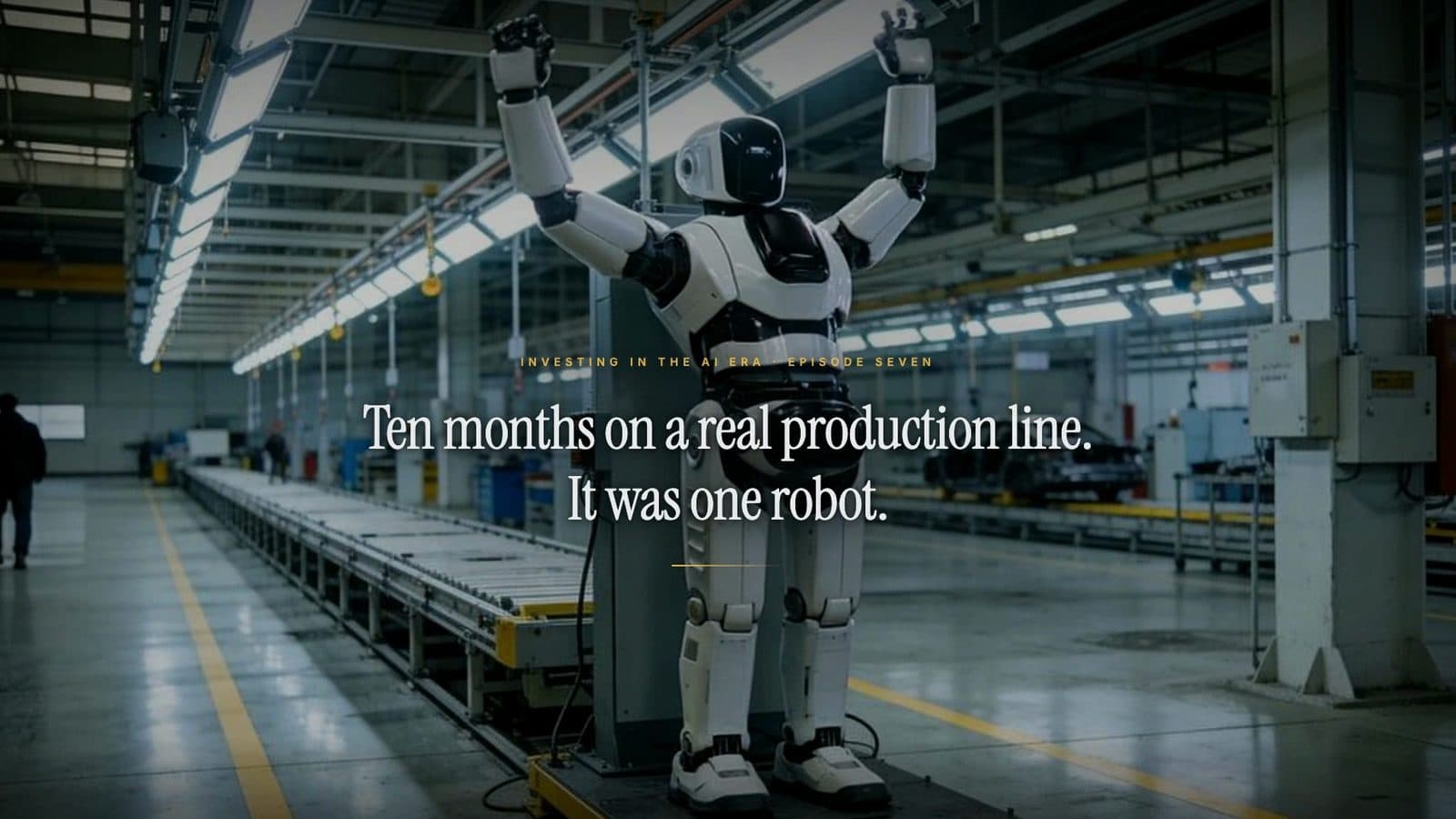
BMW's own press release of 27 February 2026 states that its Spartanburg humanoid deployment was a pilot using ONE Figure 02 robot, which over ten months in 2025 logged about 1,250 operating hours, moved more than 90,000 components and supported production of over 30,000 BMW X3s.
Source: BMW Group press release T0455864EN (opens press.bmwgroup.com)
Event 2025 (ten-month pilot) · Published 27 Feb 2026
Limits: 1,250 hours of real production-adjacent work is genuine and non-trivial. The claim is about SCALE and commercial status, not about capability. BMW does not disclose what it paid.
Research note
FALSIFIER: BMW is expanding, not retreating — the same release announces a second pilot at Plant Leipzig with Hexagon's AEON from summer 2026, and Figure 03 entered Spartanburg for logistics sortation in June 2026. If a multi-unit paid deployment is disclosed, the cold open needs restating.
- FactFrontier · Aug 2026Primary sourceF02
Unitree's final registered STAR Market prospectus of 14 August 2026 discloses audited FY2025 revenue of RMB 1,699.27 million, up from RMB 392.77 million in FY2024, having shipped more than 5,500 humanoid robots in 2025 — more than any company in the world.
Source: Unitree Technology final STAR Market IPO prospectus (opens sse.com.cn)
Event FY2025 · Published 14 Aug 2026
Limits: The RMB 868m humanoid revenue line may include components, spares and services alongside finished robots, so a per-unit price derived from it is arithmetic, not a disclosed ASP. Most Unitree humanoids go to research, education and entertainment buyers, not to production-line work. An earlier draft prospectus (20 March 2026) gave FY2025 revenue as RMB 1,708.21m — pre-audit; use the audited 1,699.27m for any ratio.
Research note
The round number RMB 1.70 billion is true of both the draft and the audited figure and is what goes on screen.
- FactFrontier · Aug 2026Primary sourceF03
Unitree published its own price-to-sales ratio in its listing announcement: 35.89 times FY2025 audited revenue at the IPO price of RMB 150.80, warning in the same document that its 219.23x price-to-earnings ratio was above its sector's 38.56x.
Source: Unitree STAR Market Listing Announcement (688836) (opens sse.com.cn)
Event 19 Aug 2026 · Published 18 Aug 2026
Research note
COMPANY-STATED RATIO, not the film's arithmetic — the strongest possible provenance for a valuation multiple on screen. An independent recomputation (404,464,340 shares x RMB 150.80 / RMB 1,699.27m) reproduces 35.89 exactly.
- FactFrontier · Sep 2026Primary sourceF04
Unitree opened its first trading day on 19 August 2026 at RMB 1,100.00, up 629% on the issue price, and closed at RMB 845.00, up 460% — a market capitalisation of about RMB 341.8 billion, roughly 201 times FY2025 revenue. By the close of 2 September 2026 the shares were RMB 546.02, about 130 times revenue and 35% below the debut close.
Source: Shanghai Stock Exchange daily market data, 688836 (opens sse.com.cn)
Event 19 Aug 2026 · Published 2 Sep 2026
Limits: The 201x and 130x multiples are the film's arithmetic on the exchange's own closing prices and the company's own share count and audited revenue; only the 35.89x at the issue price is company-stated. Widely quoted USD figures ('about $50 billion') are broadly consistent but rest on an unstated exchange rate — the film uses the RMB figures.
Research note
FALSIFIER: a further move in either direction restates this. The date is on screen for exactly that reason.
- FactFrontier · Jun 2026ResearchF05
In a real-world benchmark published on 15 June 2026, five generalist robot manipulation policies were run through 2,700 physical rollouts; the best performer, Pi0.5, scored 94.3% on atomic instruction-following tasks on a Franka arm but only 15.8% on held-out compositional tasks, and three of the five scored at or below 3.3% on composition, one of them at zero.
Event Jun 2026 · Published 15 Jun 2026
Limits: An arXiv preprint, not yet peer-reviewed — the WEAKEST source carrying anything in this film. Tabletop research arms, not a commercial deployment. Success rates are for the authors' chosen task set and do not transfer to any shipping product. These are zero-shot or lightly-adapted evaluations of general policies; a commercial deployment fine-tuned on its own environment would score far higher on its own tasks.
Research note
MITIGATION: the frame names the benchmark and both institutions on screen rather than burying them in the receipt, and NO other scene depends on this fact. If the preprint were withdrawn tomorrow the episode's mechanism survives on F06-F07 alone.
- FactPrimary sourceF06
Ocado Intelligent Automation publishes a burst rate of 630 units per hour for its on-grid robotic pick system, with more than 50 pick arms operational across customer fulfilment centres, and states on the same page that the system is 'Backed-up by a "remote pilot" to intervene and handle the rare exceptions'.
Source: Ocado Intelligent Automation, OCADEX/Pick product specification (opens ocadogroup.com)
Event undated company product page · Published 2 Sep 2026
Limits: The page is undated and 630 UPH is a BURST rate the company calls a theoretical maximum; Ocado explicitly notes real-world performance varies with item size and complexity. The '~100% accuracy' claim on the same page refers to item RECOGNITION, not end-to-end pick success. No exception rate is disclosed.
Research note
This is the only DISCLOSED input to the nines arithmetic in F07 and the frame labels it as such.
- InterpretationPrimary sourceF07
Eight hours at Ocado's published 630 units per hour is 5,040 picks, so a 99% success rate would hand a human 50.4 exceptions per arm per shift — one every nine and a half minutes — while 99.9% gives 5.0, and getting down to a single exception per shift requires 99.98%: a fiftyfold cut in the failure rate.
Source: Derived by DowJo from Ocado's published 630 UPH burst rate (F06) (opens ocadogroup.com)
Event derivation dated 2026-09-02 · Published 2 Sep 2026
Limits: THE SUCCESS RATES ARE ILLUSTRATIVE AND ARE NOT OCADO'S. Ocado does not disclose its pick success rate. Only the 630 UPH throughput and the 50+ arm count are sourced. This must be narrated explicitly as arithmetic ON a disclosed throughput, never as Ocado's performance — and the frame carries ILLUSTRATIVE SUCCESS RATE on the axis and the full working in the corner. Exceptions are also not all equal: a remote pilot may resolve several in seconds, so exception count is an upper bound on labour, not a headcount.
Research note
Full working, re-derived by assertEvidence() at render time: 630 x 8 = 5,040; 5,040 x 0.01 = 50.4; 480 min / 50.4 = 9.52 min; 1 - 1/5,040 = 99.9802%; 0.01 / (1/5,040) = 50.4x.
- FactFrontier · Apr 2026Primary sourceF08
Amazon announced on 30 June 2025 that it had deployed its one millionth warehouse robot, into a robotics network spanning more than 300 facilities worldwide; in his 2025 letter to shareholders published in April 2026 Andy Jassy restated 'over one million robots operating in fulfillment centers'.
Event 30 Jun 2025 · Published Apr 2026
Limits: The million units are overwhelmingly floor-drive movers and fixed arms, not general-purpose or humanoid machines. Amazon is a vertically integrated single customer building for its own network — not a market anyone else can sell into. Amazon has restated 'over one million' rather than updating the count since June 2025. Headcount is deliberately NOT narrated: labour is Episode 8's subject.
Research note
Amazon's environment is engineered around its robots — fixed grids, standardised totes, controlled lighting — which is precisely why this fact supports the boundary thesis rather than a capability one.
Show the remaining 30 pieces of evidence
- FactPrimary sourceF09
Amazon states in its own 10-K filings that fulfilment expense was 15.8% of net sales in FY2023, 15.4% in FY2024 and 15.2% in FY2025 — an improvement of roughly half a percentage point over two years — while fulfilment expense in absolute dollars rose from $90.6 billion to $109.1 billion.
Event FY2023-FY2025 · Published 6 Feb 2026
Limits: The '55 vs 60 basis points' ambiguity is a rounding artefact of one filing, not a conflict: subtracting Amazon's own printed percentages gives exactly 60bp; computing from the dollar line items in the same filing gives 55.2bp. THE FILM SAYS 'roughly half a percentage point', which is true either way. The gain is also decelerating — 32.5bp in FY2024, 22.6bp in FY2025.
Research note
Narrated as the cost of getting a box out the door, never as a wage bill. This fact is used to state an AMBIGUITY honestly, not as proof the robots paid.
- FactFrontier · Feb 2026Primary sourceF10
Amazon's FY2025 Form 10-K does not contain the word 'robot' once; the annual report refers only generically to 'automation, artificial intelligence, and machine learning technologies' in its risk factors.
Source: Amazon.com, Inc. Form 10-K for FY2025 (opens sec.gov)
Event FY2025 · Published 6 Feb 2026
Limits: A verified absence, established by full-text search of the filing. The absence is not evidence of concealment — a 10-K describes financial condition, not equipment inventories.
Research note
FALSIFIER: the FY2026 10-K, expected early 2027. Used in the film as one of four disclosure facts, never alone.
- FactFrontier · Jul 2026Primary sourceF11
Alphabet's Other Bets segment — whose revenues, in Alphabet's own words, are 'generated primarily from the sale of autonomous transportation services and internet services' — reported $382 million of revenue and a $1,799 million operating loss for the quarter ended 30 June 2026, against $373 million and a $1,246 million loss a year earlier.
Source: Alphabet Inc., Form 8-K Exhibit 99.1 (Q2 2026) and Form 10-Q, SEC EDGAR (opens sec.gov)
Event quarter ended 2026-06-30 · Published 21 Jul 2026
Limits: OTHER BETS IS NOT WAYMO. It also contains Wing, X, GFiber and, until its Q1 2026 deconsolidation, Verily. The segment loss overstates Waymo's loss and the segment revenue is not Waymo's revenue. The film may say the SEGMENT's revenue barely moved while Waymo's ride volume doubled; it may NOT say 'Waymo's revenue is flat'. Alphabet attributes much of the increase to fleet expansion, manufacturing and R&D — growth investment ahead of revenue.
Research note
Read off the Segment Results table of the filed exhibit, not a summary. Alphabet lists 'autonomous transportation services' FIRST in its own definition, which is what lets the film link Waymo to this line honestly.
- FactFrontier · Jul 2026Primary sourceF12
Alphabet's Other Bets operating loss widened year on year in both of the last two reported quarters — up 71% in Q1 2026 ($2,100m against $1,226m) and up 44% in Q2 2026 ($1,799m against $1,246m) — over the same period in which Waymo's disclosed weekly rides roughly doubled, while segment revenue went from $450m to $411m and $373m to $382m.
Source: Alphabet Inc., Forms 8-K Exhibits 99.1 (Q1 and Q2 2026), SEC EDGAR (opens sec.gov)
Event quarters ended 2026-03-31 and 2026-06-30 · Published 21 Jul 2026
Limits: SEQUENTIALLY the loss SHRANK from Q1 2026 to Q2 2026 ($2,100m to $1,799m). The film must say which comparison it is making, every time — it makes the YEAR-ON-YEAR one, and the falsifier in F26 is written year on year for the same reason. The Q4 2025 loss of $3,617m is separately distorted by a disclosed one-time $2.1bn Waymo employee compensation charge and is not narrated.
Research note
This is the single most cinematic fact in the packet and the easiest to overclaim. See X02.
- FactFrontier · Jun 2026Primary sourceF13
Alphabet told the SEC in its Q1 2026 earnings remarks, filed as Form 8-K Exhibit 99.1 on 29 April 2026, that 'Waymo also surpassed 500,000 fully autonomous rides per week, doubling in less than a year', and restated the figure in its investor presentation of 3 June 2026.
Event 29 Apr 2026 · Published 3 Jun 2026
Limits: NOT 'paid'. The last first-party figure Waymo explicitly called PAID was 250,000 trips a week on 5 May 2025; from February 2026 both Waymo and Alphabet say 'fully autonomous rides'. Inserting the word 'paid' would put a word in their mouths. A ride count is also not revenue: Waymo has never disclosed average fare, revenue per ride or contribution margin.
Research note
PROVENANCE CORRECTION: the 500,000 figure is not a press number. Waymo published it itself at its Tokyo event on 31 March 2026 and Alphabet filed it with the SEC a month later. It must be cited to Alphabet or Waymo, never to a wire report.
- FactFrontier · Feb 2026Primary sourceF14
Waymo disclosed on 17 February 2026 that 'Every week, our vehicles drive over four million miles and provide over 400,000 rides', that it 'currently has a fleet of 3,000 vehicles', and that 'there are approximately 70 Remote Assistance agents on duty worldwide at any given time' — which works out to roughly 190 miles and 19 rides per vehicle per day.
Event 17 Feb 2026 · Published 17 Feb 2026
Limits: THE PER-VEHICLE FIGURES ARE THE FILM'S ARITHMETIC, not Waymo's disclosure (4,000,000 / 3,000 / 7 = 190.5; 400,000 / 3,000 / 7 = 19.0). All four inputs come from ONE post on ONE date, which is the only reason they may be divided into each other — the 500,000 figure in F13 belongs to a later date and must never be combined with this fleet count. '70 on duty at any given time' is a concurrent-shift count, not total headcount, which is undisclosed and necessarily several times larger. Not all vehicles are in revenue service at any moment.
Research note
Waymo's own framing is load-bearing and the film respects it: 'RA does not continuously monitor a vehicle... they respond to specific requests for information initiated by the Waymo Driver... and provide advice which the system can decide to use or reject.' The 1:43 agent-to-vehicle ratio is DERIVED and is attributed to DowJo on screen, never to Waymo.
- FactResearchF15
In a December 2024 study with Swiss Re covering 25.3 million fully autonomous miles, Waymo was involved in nine property-damage liability claims and two bodily-injury claims, against a human-driver baseline that would have produced 78 and 26 — reductions of 88% and 92%.
Event through 2024 · Published Dec 2024
Limits: Liability-claim FREQUENCY is not insurance COST: severity, defence costs and the tail risk of a single catastrophic verdict against a deep-pocketed defendant are not captured. The study is co-authored by Waymo. Waymo operates in geofenced, mapped, mostly benign Sun Belt and coastal domains; the human baseline includes conditions Waymo does not drive in, so the comparison is not like-for-like on operational design domain.
Research note
Deliberately used as COUNTEREVIDENCE to the film's own economic argument, which is the only honest place for it.
- FactFrontier · Feb 2026Primary sourceF16
California DMV data for the year to 30 November 2025, released on 20 February 2026, shows permit holders logged more than nine million autonomous test miles with total reported disengagements falling to under 9,300 from 28,800 the previous year.
Source: California DMV Autonomous Vehicle Disengagement Reports (opens dmv.ca.gov)
Event 1 Dec 2024 - 30 Nov 2025 · Published 20 Feb 2026
Limits: DISENGAGEMENT IS SELF-DEFINED AND SELF-REPORTED: companies choose what counts, and the metric EXCLUDES remote-assistance sessions entirely, so it is not the intervention rate. It covers only permitted TESTING on California public roads, not driverless deployment miles. California DMV has proposed replacing it — an admission the current metric does not measure what matters. Nuro moved the other way, from 2,044 to 646 miles per disengagement, on 25% fewer test miles.
Research note
Narrated alongside F15 as the counterevidence pair. The film says explicitly that this measures a narrower thing than the number that is actually being withheld.
- FactFrontier · Jul 2026Primary sourceF17
Aurora Innovation reported $2 million of revenue and a $266 million loss from operations for the three months ended 30 June 2026, ending the quarter with $1.217 billion of cash and short-term investments and nearly 440,000 cumulative driverless miles; its chief executive said on the 29 July 2026 earnings call that 'today, we have on order of 25 trucks that are operating'.
Source: Aurora Innovation, Inc., Q2 2026 shareholder letter (Form 8-K), SEC EDGAR (opens sec.gov)
Event quarter ended 2026-06-30 · Published 29 Jul 2026
Limits: OPERATING loss, read off the 'Loss from operations' line: revenue 2 - cost of revenue 7 - R&D 211 - SG&A 50 = (266). The NET loss for the same quarter was $270m, and the film never mixes them. THE TRUCK COUNT IS NOT IN A FILING: the full 10-Q and both shareholder letters carry only forward-looking targets ('20-25 second-generation driverless trucks by the end of the third quarter', 'exit the year with 200'), so the ~25 figure is a management statement on the call and is dated to it. Do not conflate driverless miles (~440,000) with cumulative COMMERCIAL miles (over 6 million), which include an operator on board.
Research note
Aurora reported 100% on-time performance and zero Aurora Driver-attributed collisions across those miles, and guides to $14-16m of 2026 revenue — about 6% of a single quarter's operating loss. The operational record is clean; only the denominator is small, which is exactly the construction-line point.
- FactFrontier · Aug 2026Primary sourceF18
Serve Robotics reported $3.238 million of revenue against $12.017 million of cost of revenues for the three months ended 30 June 2026 — and a labelled loss from operations of $66.065 million — while growing revenue 404% year on year and cutting full-year 2026 revenue guidance from $26 million to $9-10 million in the same release.
Source: Serve Robotics Inc., Form 10-Q and Exhibit 99.1 earnings release, SEC EDGAR (opens sec.gov)
Event quarter ended 2026-06-30 · Published 6 Aug 2026
Limits: The operating loss is the filer's own labelled line and reconciles exactly: gross loss (8,779) less R&D 20,279 + G&A 24,844 + Operations 7,862 + sales and marketing 4,301 = (66,065). The NET loss of $64.127m is NARROWER than the operating loss because of other income, so quoting net would flatter the point — the film uses operating. Cost of revenue is defined in the 10-Q as 'direct labor, depreciation of robot assets, amortization of developed technology, network and other direct costs', so the remote-supervision share is NOT isolable. A large part is depreciation over a fleet running below capacity. Serve holds $240.4m of cash.
Research note
Computed from Serve's own disclosed inputs and stated as arithmetic on screen: 9,809 daily supply hours across 91 days gives $3.63 of revenue and $13.46 of cost of revenues per robot supply-hour. Serve publishes neither.
- FactFrontier · Aug 2026Primary sourceF19
Serve Robotics stated that its guidance cut 'reflects lower than expected delivery volume through the Company's Uber Eats partnership, including a decline reflected in Q2 results and the removal of projected demand in the second half of 2026', while its daily active robots fell sequentially from 812 to 792 and daily supply hours from 10,295 to 9,809; on the same day its chief executive said 'almost 2/3 of delivery orders in our operating areas can't benefit from robotic last-mile delivery due to back of house integration barriers'.
Event 6 Aug 2026 · Published 6 Aug 2026
Limits: The guidance language is from the filed release; the 'back of house' quote is a management characterisation on the call and is not defined quantitatively. Management frames the reduction as concentrating the fleet behind the highest-return opportunities, i.e. a deliberate choice rather than a failure — the film reports that framing.
Research note
THE BINDING CONSTRAINT IS DEMAND, NOT ROBOTS, and it is in the company's own filed words. The fleet SHRANK sequentially while the company removed second-half demand from its forecast. This is the film's own counter-instrument: proof that a construction line can be building a boundary too small to reach the demand.
- FactFrontier · Aug 2026Primary sourceF20
Symbotic reported $720.8 million of revenue at a 22.3% GAAP gross margin for the quarter ended 27 June 2026, against a contracted backlog of $22.5 billion, of which it expects to recognise approximately 15% as revenue in the next twelve months and approximately 62% within the following 13 to 60 months.
Source: Symbotic Inc., Form 10-Q for the quarter ended 27 June 2026, Revenue note (opens sec.gov)
Event quarter ended 2026-06-27 · Published 5 Aug 2026
Limits: GROSS MARGIN ONLY, deliberately. Symbotic's Up-C structure produces two true net-income figures for the same quarter — $55.0m total and $11.7m attributable to common stockholders — and either alone reads as a lie beside the other. The backlog conversion is disclosed on a rolling NEXT-TWELVE-MONTHS basis, not a fiscal-year one: saying 'this fiscal year' would state something the company did not.
Research note
Gross margin rose from 18.9% a year earlier to 22.3% — the margin curve is bending the right way, and the film says so.
- FactFrontier · Aug 2026Primary sourceF21
A single customer accounted for 90.5% of Symbotic's revenue in the quarter ended 27 June 2026 and 87.0% for the nine months then ended, under a master automation agreement covering all 42 of Walmart's US regional distribution centres whose initial term runs to May 2034.
Source: Symbotic Inc., Form 10-Q (concentration schedules) and Form 10-K FY2025 (opens sec.gov)
Event quarter ended 2026-06-27 · Published 5 Aug 2026
Limits: The 10-Q identifies the customer only as 'Customer A'; the Walmart relationship is established separately in the 10-K. Concentration ROSE year on year on every measure: revenue 83.8% to 90.5%; accounts receivable 75.8% to 82.8%.
Research note
This is what pricing the boundary looks like from the inside: the fence that makes the margin possible is also the concentration risk.
- FactFrontier · Feb 2026JournalismF22
Uber committed over $100 million in February 2026 to build its own DC fast-charging depots for autonomous fleets in the Bay Area, Los Angeles and Dallas, expanding to ten US cities during 2026, stating that owning the chargers 'improves efficiency, lowers costs and keeps vehicles on the road longer, maximising utilisation and uptime'.
Source: Uber announcement, reported by Axios and electrive (opens axios.com)
Event 18 Feb 2026 · Published 19 Feb 2026
Limits: ANNOUNCED capex, not deployed capex, and no cost per depot is disclosed. The commitment is contingent on AV partners hitting delivery milestones. Kept to one clause in the film: Episode 6 owns grid, interconnection and siting.
Research note
Used only as a priced example of a boundary being built before the thing that uses it exists.
- FactFrontier · Jan 2026Primary sourceF23
Caterpillar stated on 6 January 2026 that 'more than 820 Cat autonomous trucks are in operation around the world. Together they have hauled over 11 billion tonnes of material with no reported injuries.'
Source: Caterpillar Inc., 'Building on a 40-Year Legacy of Development Expertise' (opens caterpillar.com)
Event cumulative since 2013 commercial launch · Published 6 Jan 2026
Limits: 'No reported injuries' is Caterpillar's own wording and must not be blended with Komatsu's narrower 'no systems-related injuries'. Caterpillar's 820+ count is not restricted to ultra-class trucks, so it is not like-for-like with Komatsu's 1,000 ultra-class figure. An earlier Caterpillar release (7 November 2024) gives 8.62 billion tonnes but does NOT carry the injury language anywhere near it — stitching the two documents together would be a fabrication.
Research note
The single strongest available proof that autonomy pays inside a bounded environment, in an industry nobody calls AI — and it is one Caterpillar sentence carrying truck count, tonnage and safety record together.
- FactFrontier · Apr 2026Primary sourceF24
Komatsu stated on 21 April 2026 that it had become the first manufacturer to commission 1,000 ultra-class autonomous haul trucks, and that customers using its FrontRunner system have collectively moved over 11.5 billion metric tons of material since commercial introduction in 2008.
Event cumulative since 2008 · Published 21 Apr 2026
Limits: Komatsu got to market in 2008, five years before Caterpillar, and has moved MORE material — so the film must not imply Caterpillar leads. Komatsu's safety wording is the narrower '0 systems-related injuries' and is quoted as its own phrase, never blended with Caterpillar's.
Research note
Included so the Caterpillar beat cannot be read as a single-company anecdote. Komatsu publishes no productivity percentage; Caterpillar's site-reported 20% is the only first-party one and carries Caterpillar's own attribution hedge.
- FactFrontier · Sep 2025Primary sourceF25
The International Federation of Robotics recorded 542,076 industrial robots installed worldwide in 2024 — the second-highest annual count in history and 2% below the all-time peak of 552,946 units set in 2022 — while Europe fell 8% to 85,006 units and the Americas fell 10% to 50,077, and China set a national record at 295,045 units, 54% of the world total.
Event 2024 calendar year · Published 25 Sep 2025
Limits: These are INSTALLATIONS — a flow, and units shipped rather than units running. A one-year regional decline in a lumpy order-driven market is not a trend by itself; automotive re-tooling cycles alone move these numbers. Widely repeated secondary claims that 2023 was the all-time high are WRONG: 2023 was 541,302, below 2022.
Research note
FALSIFIER: World Robotics 2026, published 24 September 2026, carries the first full-year 2025 world figure. IFR's own forecast was 575,000 for 2025 — a forecast, never drawn as a data point.
- FactFrontier · Sep 2025Primary sourceF26
The worldwide operational stock of industrial robots reached 4,663,698 units at the end of 2024, up 9% on the year and growing at an average 11% a year since 2019 — in the same year the annual installation flow sat 2% below its peak.
Event end of 2024 · Published 25 Sep 2025
Limits: IFR ESTIMATES operational stock by assuming an average robot service life (typically twelve years) and retiring units accordingly. It is a MODEL, not a census, and it is NOT the cumulative sum of the installation flow — the chart must never draw it as the area under the flow. A growing stock also does not mean growing utilisation: a robot counted as operational may be running one shift or none.
Research note
The contrast between a falling flow and a rising stock is the whole point of the scene, and assertEvidence() refuses to render if it ever stops being true in the data.
- FactFrontier · Jun 2026Primary sourceF27
United States industrial robot installations fell 9% to 34,164 units in 2024 and then rose 11% to a preliminary 38,000 units in 2025, with automotive at 13,500 units — still 1% below the prior year — and the food industry up 30%.
Event 2024 and 2025 calendar years · Published 18 Jun 2026
Limits: The 2025 figure is PRELIMINARY and is the only 2025 actual IFR has published for any major market. 38,000 units remains below the US peak; 'double-digit growth' here is a rebound off a trough, not a new high. Automotive — historically the sector that sets the tone — did not participate.
Research note
This is the film's evidence that the flow is a CYCLE that turns back up, not a secular decline. Without it the episode would be making a directional bet it cannot support.
- FactPrimary sourceF28
FANUC states in its own statutory Annual Securities Report for the year ended 31 March 2026 that its products are producer goods strongly susceptible to the effects of economic fluctuations, and that it therefore manages from a long-term perspective not swayed by short-term events; its English Integrated Report renders the same stance as 'We are in the capital goods industry, therefore we are subject to no small extent the effects of economic fluctuations and changes in companies' interest in capital investment.'
Event FY ended 2026-03-31 · Published 22 Jun 2026
Limits: DATE MISMATCH TO STATE ON SCREEN: the English wording is from the Integrated Report covering the year ended 31 March 2025; the statutory Japanese quote is the current-year one. FANUC's own English materials render 生産財 as 'capital goods'. FANUC is not a business in decline — it reported a 23.2% operating margin on revenue up 17.7% for the quarter ended 30 June 2026.
Research note
The film uses this as the industry describing its own cyclicality in a regulatory filing, not as evidence that robotics is a poor business.
- FactFrontier · Jan 2026Primary sourceF29
ABB announced on 8 October 2025 that it had agreed to sell its Robotics division to SoftBank Group for an enterprise value of $5.375 billion — about two and a third times the division's revenue — abandoning its earlier plan to spin the business off as a separately listed company.
Event 8 Oct 2025 · Published 29 Jan 2026
Limits: THE MULTIPLE IS THE FILM'S ARITHMETIC — ABB never publishes one. On the press release's $2.3bn of 2024 revenue it is 2.34x; on Note 3's precise $2,267m it is 2.37x; on 2025's $2,331m it is 2.31x. 'About two and a third times revenue' is safe on all three. The enterprise value also includes certain investments and real estate previously in Corporate and Other, so the pure robotics multiple is marginally lower. The deal was still subject to EU, China and US approvals and had not closed.
Research note
SoftBank is paying a strategic price for a physical-AI platform, so this may reflect ABB's willingness to exit as much as the asset's standalone worth — the film says a sophisticated buyer paid a machinery multiple, not that the business is worth only that.
- FactFrontier · Jul 2026Primary sourceF30
Harmonic Drive Systems, whose strain-wave gears sit in robot joints worldwide, reported an operating margin of 4.3% for the year ended 31 March 2026 — and 0.0% the year before, on operating profit of 6 million yen against 55,645 million yen of revenue — while its customer FANUC reported a 23.2% operating margin for the quarter ended 30 June 2026.
Source: Harmonic Drive Systems Inc. (TSE 6324) 決算短信; FANUC Corporation (TSE 6954) 決算短信 (opens hds.co.jp)
Event FY ended 2026-03-31 and quarter ended 2026-06-30 · Published 31 Jul 2026
Limits: 4.3% and 0.0% are the COMPANY'S OWN stated 売上高営業利益率, not the film's calculation. The margin was depressed by low factory utilisation and by amortisation on the Harmonic Drive SE acquisition, so it is a cyclical trough rather than a structural ceiling: the June 2026 quarter recovered to 11.0% with order intake up 55.7%, and FY2027 guidance implies about 11.4%. The FANUC figure is consolidated across four divisions, not robots alone. Nabtesco's precision-reducer segment earned 10.6% in H1 2026, so 4.3% is not the whole reducer industry.
Research note
The point the film makes is narrow and survives the qualification: holding the chokepoint did not confer the margin. Episode 5 taught that power migrates TO the constraint; this is the counter-case, and the film states it as a counter-case rather than re-teaching Episode 5.
- FactFrontierPrimary sourceF31
The IEA reports that China accounted for 60% of global mined production of magnet rare earths, 91% of global refined output and 94% of permanent-magnet manufacturing in 2024, up from roughly 50% of magnet manufacturing in 2005.
Source: International Energy Agency, Rare Earth Elements (opens iea.org)
Event 2024 · Published 2026
Limits: 'Magnet rare earths' means the NdPr/Dy/Tb subset, not all seventeen elements; the 94% is manufacturing capacity and output, not consumption. The IEA estimates roughly $60bn of investment over a decade could materially diversify this, so the gap is capital-solvable rather than geologically fixed — USGS shows Brazil holds 21.0 million tonnes of reserves against China's 44.0 million.
Research note
Narrated as an INPUT CONCENTRATION fact. Export-control policy is Episode 11's subject and is on the do-not-narrate list.
- FactFrontier · Jan 2026Primary sourceF32
The United States was 100% net-import-reliant on heavy rare earths in every year from 2021 through 2025, and remained 67% net-import-reliant for rare-earth compounds and metals overall in 2025 despite mining an estimated 51,000 tonnes of rare-earth oxide that year.
Source: USGS Mineral Commodity Summaries 2026, Rare Earths chapters (opens usgs.gov)
Event 20 2021 · Published Jan 2026
Limits: USGS notes there are no domestic trade codes for individual heavy rare earths, so these import shares are estimated from commercial shipping records and exclude heavy rare earths already embedded in imported finished goods. The overall net import reliance moved from >95% in 2021-23 to 53% in 2024 and 67% in 2025 — the 2025 worsening reflects imports surging as buyers stockpiled, not a loss of capability. US production of rare-earth compounds and metals rose from 120 tonnes in 2021 to an estimated 8,900 in 2025.
Research note
The refining gap is closing fast from a very small base, and the film says so rather than leaving the concentration figure to imply permanence.
- FactJournalismF33
Ford halted Explorer production at its Chicago Assembly plant for a week in May 2025 after a supplier ran out of rare-earth magnets, and chief executive Jim Farley said in June 2025 that rare-earth supply was being managed 'day to day'.
Source: The Detroit News (opens detroitnews.com)
Event May 2025 · Published 13 Jun 2025
Limits: Ford said the Chicago downtime had been partly planned and was simply shifted, so this is evidence of fragility rather than necessarily a week of lost output. The disruption was measured in weeks, not quarters, and normal production resumed once licences flowed — the chain bent rather than broke.
Research note
The film's ONE physical consequence of input concentration. The licensing chronology behind it belongs to Episode 11 and is on the do-not-narrate list.
- FactFrontier · Aug 2026Primary sourceF34
The last year NVIDIA disclosed Automotive revenue as its own line was fiscal 2026, at $2,349 million against $193,737 million of Data Center revenue; from the first quarter of fiscal 2027 it changed its revenue-by-market-platform presentation, merging Gaming, Professional Visualization, Automotive and OEM into a single 'Edge Computing' line of $7,198 million against $89,023 million of Data Center for the quarter ended 26 July 2026.
Event FY2026 and Q2 FY2027 · Published 26 Aug 2026
Limits: CRITICAL: 'EDGE COMPUTING' IS NOT A ROBOTICS LINE. It is the former Gaming + Professional Visualization + Automotive + OEM & Other lines merged, and Gaming dominates it — NVIDIA's own commentary attributes the $7.2bn to 'strong sales of Blackwell workstations, partially offset by slower consumer PC sales' and mentions neither robotics nor automotive. Automotive was running about $586m a quarter before it vanished. The narratable fact is that the AUTOMOTIVE LINE STOPPED BEING PUBLISHED, not that $7.2bn is a physical-AI number. This is also a market-platform presentation change, NOT a segment change: the two reportable segments are unchanged.
Research note
The composition was established by exact arithmetic across three recast periods. Automotive grew every year it was disclosed — $1,091m, $1,694m, $2,349m — and was 1.1% of revenue when it disappeared.
- FactFrontier · Mar 2026Primary sourceF35
Senator Edward J. Markey wrote to seven autonomous-vehicle companies on 3 February 2026 — Waymo, Tesla, Zoox, Aurora, Nuro, Motional and May Mobility — asking in question 1(c) for 'The frequency with which remote assistance sessions are invoked (for example, number of sessions per vehicle-mile or per trip), and the proportion of sessions that result in human input that alters the vehicle's driving plan'; his report of 31 March 2026 found that 'Every AV company refused to disclose how frequently their RAOs intervene to help their self-driving cars.'
Event 3 Feb 2026 · Published 31 Mar 2026
Limits: A Senate office report based on company responses to oversight letters, not sworn testimony or a regulatory filing. Companies argued the metric is misleading because remote operators generally advise rather than drive, so a raw intervention count would not map cleanly to autonomy level — a fair objection the film states.
Research note
Question 1(c) is quoted verbatim on screen. Markey's report also records that Tesla said its remote operators can take control of a vehicle and drive it at up to 10 mph while still declining to say how often — used as a bounded Tesla case, never as a Tesla thesis.
- FactFrontier · Jul 2026Primary sourceF36
Tesla discloses no Optimus unit count and no robotaxi fleet count in its FY2025 Form 10-K, its Q2 2026 Form 10-Q or its Q2 2026 shareholder deck — yet its filings define both metrics as CEO-award vesting milestones ('1 million bots delivered', '1 million Robotaxis in commercial operation'), with custom XBRL units for counting them.
Event FY2025 and Q2 2026 · Published 23 Jul 2026
Limits: A VERIFIED ABSENCE across three named documents, not an inference. Absence of a disclosed number is not proof of zero production: Tesla does publish metros served and cumulative paid robotaxi miles, and the Fremont Optimus line is real installed capex. This is a disclosure fact, not a capability claim, and it is one of four in the scene rather than standing alone.
Research note
Tesla's XBRL tagging carries custom units tsla:botDelivered and tsla:robotaxi — machine-readable units for counting robots, used to express a compensation threshold and never to report a count.
- FactPrimary sourceF37
General Motors' own segment disclosures record $10,885 million of cumulative EBIT-adjusted loss at Cruise across 2016-2024 against $770 million of lifetime revenue — about $14 of loss for every $1 of revenue — before GM announced on 10 December 2024 that it would stop funding the robotaxi business; TuSimple went from a $71.24 peak close in June 2021 to below $1 for thirty consecutive sessions and deregistered in February 2024, and Embark Trucks went from a $5.16 billion implied market capitalisation at its 2021 merger to a $2.88-a-share cash sale of about $67 million in August 2023.
Event 20 2023 · Published 10 Dec 2024
Limits: THE CRUISE CUMULATIVE FIGURES ARE ARITHMETIC ON GM'S OWN SEGMENT DISCLOSURES, summed year by year — GM never publishes a total, and the film attributes the summing to itself. EBIT-adjusted excludes restructuring charges, so it UNDERSTATES the cash cost. GM also footnotes that Cruise revenue was largely related-party engineering and services revenue. Cruise's proximate trigger was an October 2023 safety incident and the regulatory suspension that followed, not purely unit economics. TuSimple was not bought — it walked away from the public market, and its exit was entangled with a technology-transfer controversy. Applied Intuition and Aurora absorbed teams and IP, so some value was recycled rather than annihilated.
Research note
UPGRADED BY THE RECONCILIATION PASS from a press reconstruction ('a reported $10bn against under $500m') to figures derived from GM's own filed segment lines. The by-year series is: 2016 (171), 2017 (613), 2018 (728), 2019 (1,004), 2020 (887), 2021 (1,196), 2022 (1,890), 2023 (2,695), 2024 (1,701).
- FactFrontier · Aug 2026Primary sourceF38
Pony.ai reported a labelled loss from operations of US$65.7 million on US$36.2 million of total revenue for the quarter ended 30 June 2026, with a robotaxi fleet of 1,975 vehicles; WeRide reported an operating loss of RMB421.9 million (US$62.2 million) on RMB231.7 million of revenue for the same quarter.
Event quarter ended 2026-06-30 · Published Aug 2026
Limits: PONY'S OPERATING LOSS IS COMPANY-WIDE — it covers robotaxi, robotruck and intelligent solutions, and Pony discloses NO robotaxi-segment operating loss. That is why the chart pairs it with TOTAL revenue of $36.2m rather than the $12.1m robotaxi line: pairing a segment revenue with a company-wide loss would be dishonest. Pony has three different loss figures for the same quarter — operating $(65.7)m, net $(45.4)m, net attributable $(59.8)m. WeRide reports as a SINGLE operating segment and states it presents 'no further discrete financial information', so no robotaxi revenue exists for it at all; its fleet count is as of 31 July 2026, a different date from its financials.
Research note
Included so the unbounded population is a population rather than two anecdotes. All four unbounded companies publish a labelled operating-loss line for the identical quarter, so the chart needs no normalisation and invents nothing.
4 further audited series are recorded but not drawn
Annual worldwide industrial robot installations
Source: IFR World Robotics 2025 — Executive Summary (exact counts 2022-2024) and the World Robotics 2025 annual-installations chart (2014-2021, IFR's own rounded labels in thousands) · Audit: 2022 is the maximum of the series and assertEvidence() proves it at render time; the 2024-against-peak ratio (-2.0%) is re-derived rather than typed. 2014-2021 points are IFR's own rounded chart labels and are marked as such in the data module. IFR's 575,000 forecast for 2025 is deliberately NOT a point in this series.
Worldwide operational stock of industrial robots
Source: IFR World Robotics 2025 press-conference deck (2014-2023) and Executive Summary (exact 2024 count) · Audit: NOT the cumulative sum of the installation flow — IFR models it on an assumed service life and retires units accordingly. The chart draws it with different geometry and its own label for exactly this reason, and assertEvidence() refuses to render if the stock ever stops rising in the year the flow falls.
Human exceptions per pick arm per eight-hour shift, by success rate
Source: Derived from Ocado Intelligent Automation's published 630 units/hour burst rate · Audit: ONE disclosed input, illustrative rates, and the frame says so three separate ways. assertEvidence() re-derives 50.4, 9.52 minutes, 5.04 and the fiftyfold ratio from the constants and proves the curve is monotonically decreasing.
One quarter, one measure — revenue against loss from operations
Source: Alphabet, Aurora, Serve Robotics, Pony.ai and Symbotic filings for the June 2026 quarter, SEC EDGAR · Audit: ONE MEASURE, NOT MIXED. The reconciliation established that all four unbounded companies publish a LABELLED loss-from-operations line for the identical quarter, so no normalisation was needed and none was invented. The measure is still drawn on every bar because net loss differs materially from operating loss at three of the four. Symbotic carries a gross margin and no loss line because it did not lose money — assertEvidence() forbids a net line on that row (Up-C ambiguity), requires every unbounded row to lose more than it earns, and proves the one bounded company out-earns the whole unbounded set, which is the sentence the narrator says.
The strongest case against this
The open-road autonomy cohort of 2021-2024.
Carried at full strength, before the conclusion — not as a footnote.
TuSimple listed above $8bn and delisted; Embark went public at $5.16bn and sold for $71m; Cruise accumulated a reported $10bn of losses against under $500m of lifetime revenue; Argo AI was closed by Ford and Volkswagen. Same era, comparable capital, comparable talent — and an unbounded operating scope. This is the counter-case to the mining case, and the two together are the episode's argument.
Limits: Each failure had its own proximate trigger — a safety incident, a technology-transfer controversy, a funding-market turn — so the pattern is suggestive rather than causal, and the film says so. Waymo, operating in the same cities under the same regulator, reached 500,000 rides a week, which means the failure was not the category.
History, under test
The strongest historical case
What the past licenses — and, stated just as plainly, what it does not.
Autonomous haulage in mining — the deployment that worked, at scale, for over a decade, in an industry nobody calls AI.
Komatsu commercialised autonomous haulage in 2008 and Caterpillar in 2013. Between them they have commissioned over 1,800 autonomous haul trucks and moved more than 22 billion tonnes of material, with safety records both companies publish in their own words (F23, F24). Nothing about the intelligence was harder than a city street; everything about the BOUNDARY was easier — a private site, a fixed route network, a controlled traffic environment, one owner of the whole system, and a customer who already buys capital equipment on a payback calculation. It is the film's cleanest proof that the boundary, not the model, is what decides whether physical autonomy earns.
Limits: Mining haulage is not a general-purpose robot and the film must not imply the lesson transfers mechanically. What transfers is the QUESTION — what does the boundary cost, and who paid to build it — not the answer.
What remains uncertain
What we still do not know
Stated by the research team, in full, rather than smoothed over.
- The intervention rate. All seven companies refused it (F35), and it is the number that would actually price autonomy's operating line. The film's closing argument rests on this absence rather than pretending to resolve it.
- Whether Amazon's million robots paid. Not resolvable from the filings (X15), and narrated as an open question.
- Waymo's standalone economics. Not disclosed anywhere in Alphabet's SEC filings; any per-ride figure in circulation is a model (X02).
- Whether Harmonic Drive's 4.3% is a cyclical trough or a structural ceiling. The June 2026 quarter recovered to 11.0% with order intake up 55.7%, which is consistent with a trough. The film's narrow claim — that holding the chokepoint did not confer the margin over the full year — survives either reading, and the recovery is stated.
- Whether the boundary-building phase ends. The whole thesis is that construction spending resolves into an operating line eventually; the packet cannot prove it does. That is why the falsifier is a filing schedule rather than an argument.
What we refused to publish
16 claims we would not say — and why
The do-not-narrate list. Some are popular; some are true but unproven; some are simply not this note’s to make. Each refusal is enforced in production, not just recorded.
- RefutedX01
“The cost of remote assistance is what makes autonomy unprofitable.”
Verdict: REFUTED by the packet's own arithmetic
Why: THE EPISODE'S ORIGINAL SPINE, killed by its own adversarial pass. Waymo's ~70 on-duty agents (F14), grossed up to round-the-clock coverage, is a low-tens-of-millions annual line against a $1,799m quarterly segment operating loss (F11). The exception layer is the reason a boundary must exist; it is NOT the cost structure, and any sentence implying otherwise fails a viewer's own division.
- UnverifiableX02
“Waymo's revenue is flat / Waymo lost $1.8 billion in the quarter.”
Verdict: UNVERIFIABLE — Waymo is not a reported segment
Why: Other Bets bundles Waymo with Wing, X and GFiber. Alphabet has never broken Waymo out, and Waymo's standalone revenue, cost per ride and unit economics are not disclosed anywhere in Alphabet's SEC filings. The film may say the SEGMENT's revenue barely moved while Waymo's ride volume doubled. Any per-ride revenue or margin figure encountered elsewhere is somebody's model.
- Partly unverifiableX03
“Autonomous trucking is cheaper than a driver / Aurora's $0.85 per mile beats the $1.028 driver-compensation line.”
Verdict: PARTIALLY UNVERIFIABLE and out of scope
Why: TWO REASONS, either sufficient. It is a wage comparison wearing a price tag, and wages, labour displacement and margins are EPISODE 8's subject. And the $0.85 is a forward target rate for a product Aurora plans to transition customers onto from 2027, not a realised average selling price — the company booked $2m of revenue in the quarter. The entire Aurora pricing beat was cut from the film before scripting rather than hedged.
- UnresolvableX04
“China's export controls created a magnet shortage / the licensing regime is selective permission dressed as scarcity.”
Verdict: UNRESOLVABLE HERE — reserved territory
Why: EPISODE 11 owns export controls and China policy as a subject, and this reading is its spine. Spending it here would leave Episode 11 with nothing. The packet holds the full April/October/November 2025 chronology, the 17-vs-333-tonne yttrium collapse and the 62,585-tonne record total export year; NONE of it is narrated. Episode 7's legitimate share is input concentration (F31, F32) and one physical consequence (F33).
- UnresolvableX05
“A million Amazon robots rival its 1.5 million employees / robots are displacing warehouse labour.”
Verdict: UNRESOLVABLE HERE — reserved territory
Why: EPISODE 8 owns labour. F08 and F09 are narrated strictly as scale and as the cost of getting a box out the door. The one academic citation in the packet (Koch, Manuylov and Smolka, Economic Journal 2021) is used for its OUTPUT finding only; its labour-share and employment results are Episode 8's.
- RefutedX06
“China's robot density collapsed from 470 to 166 robots per 10,000 manufacturing employees.”
Verdict: REFUTED — it is a denominator restatement, not a decline
Why: IFR states the new figure is 'based on updated labor market data issued by China's National Bureau of Statistics'. No robots were removed. Both figures are first-party IFR from different report editions and are NOT comparable as a series. It costs about 25 seconds to explain, teaches nothing about this episode's thesis, and invites the viewer to distrust every other number in the film. CUT ENTIRELY — and with it the whole density league table, which cannot be shown without inviting the question.
Show the remaining 10 refused claims
- RefutedX07
“NVIDIA folded robotics into a $7.2 billion 'Edge Computing' line, so physical AI is 7.2 billion against 89 billion of data centre.”
Verdict: REFUTED — the line is dominated by Gaming
Why: CORRECTED BY THE RECONCILIATION PASS, AND THE ORIGINAL FRAMING WOULD HAVE BEEN A VISIBLE ERROR. 'Edge Computing' is the former Gaming + Professional Visualization + Automotive + OEM lines merged, proven by exact arithmetic across three recast periods, and NVIDIA's own commentary attributes it to Blackwell workstations and consumer PCs without mentioning robotics at all. The narratable version is F34: the AUTOMOTIVE LINE, last disclosed at $2,349m for fiscal 2026, stopped being published.
- Partly unverifiableX08
“Waymo has completed more than 20 million trips (as a September 2026 fact) / Waymo runs 500,000 rides a week across a 3,000-vehicle fleet.”
Verdict: PARTIALLY UNVERIFIABLE — stale boilerplate and mixed dates
Why: TWO SEPARATE TRAPS. Waymo has published no cumulative trip count newer than 'over 20 million' (December 2025) and repeats the phrase verbatim in August 2026, which is boilerplate, not disclosure — at the disclosed run-rate the true figure is materially higher but Waymo has not said so. And the 500,000 figure (April 2026, F13) must never be divided by the 3,000-vehicle fleet (February 2026, F14): mixing the dates manufactures a utilisation number nobody published. Every per-vehicle figure in the film comes from the single 17 February 2026 post.
- Partly unverifiableX09
“Symbotic earned $55 million of net income in the quarter / about 12% of its backlog converts this fiscal year.”
Verdict: PARTIALLY UNVERIFIABLE — two true net figures, and the wrong conversion basis
Why: The Up-C structure produces $55.0m of total net income and $11.7m attributable to common stockholders for the SAME quarter; both are true and using either alone reads as a lie beside the other, so the film uses GROSS MARGIN only. And the conversion percentage is disclosed on a rolling NEXT-TWELVE-MONTHS basis at approximately 15% — there is no fiscal-year conversion figure in the filing, so saying 'this fiscal year' would state something the company did not.
- RefutedX10
“Caterpillar's autonomous trucks moved 8.6 billion tonnes with no reported injuries.”
Verdict: REFUTED as a single fact — it stitches two documents together
Why: The 8.62-billion-tonne figure is real and is Caterpillar's own (7 November 2024), but that release carries NO injury language anywhere near it. 'No reported injuries' belongs to the 11-billion-tonne sentence of 6 January 2026 and, separately, to the original 2013 Western Australia fleet. Narrate the 2026 sentence (F23), which carries truck count, tonnage and safety record together in Caterpillar's own words.
- UnverifiableX11
“Tesla will have a million robotaxis / Optimus production will reach any stated figure.”
Verdict: UNVERIFIABLE — forward statements
Why: Tesla targeted 5,000 Optimus units in 2025 and has disclosed no production count in any filing. The million-bot and million-robotaxi figures that DO appear in its filings are CEO-award vesting thresholds, not forecasts the company stands behind as guidance. The bounded-Tesla rule holds: Tesla appears in this film twice, both times as a disclosure fact.
- UnverifiableX12
“Morgan Stanley estimates Optimus's bill of materials rises from about $46,000 with Chinese suppliers to about $131,000 without them.”
Verdict: UNVERIFIABLE at the precision claimed
Why: A sell-side scenario reported via secondary press — broker estimate of a product not in volume production, so the $46,000 base is itself an estimate. The durable insight is the ratio, and the film does not need it: F31 and F32 make the input-concentration point on IEA and USGS paper, which is strictly stronger.
- UnverifiableX13
“Ocado's robotic pick arms succeed 99% of the time / hand a human 50 exceptions a shift.”
Verdict: UNVERIFIABLE — the success rate is not disclosed
Why: ONLY the 630 units-per-hour burst rate is Ocado's. The success rates in F07 are the film's own illustration and must be narrated as arithmetic ON a disclosed throughput. The frame carries ILLUSTRATIVE SUCCESS RATE on the axis, the working in the corner, and the disclosed input in its own labelled box precisely so the two can never be confused.
- RefutedX14
“Waymo says one remote-assistance agent covers 43 vehicles.”
Verdict: REFUTED as an attribution
Why: Waymo has never published a ratio. Dividing its own two adjacent figures gives roughly 1:43, but the arithmetic is DowJo's and must be attributed on screen as such. It is also concurrent-agents-to-total-fleet rather than agents-to-vehicles-in-service, which flatters it. Waymo's framing — advice the system can reject, not remote driving — is stated whenever the number is.
- UnresolvableX15
“Amazon's robots delivered the fulfilment-cost improvement.”
Verdict: UNRESOLVABLE — MUST BE STATED AS UNKNOWN
Why: F09 establishes that fulfilment expense fell about half a percentage point of sales over two years while absolute fulfilment dollars rose $18.5 billion. Whether the robots paid, or the savings were consumed by speed and capacity, is not resolvable from the filings. The film narrates the AMBIGUITY in one honest line — a million robots bought speed and capacity, not a margin you can see — and never claims causation in either direction.
- UnverifiableX16
“Pony.ai lost $65.7 million on its robotaxi business / WeRide's robotaxi revenue was X.”
Verdict: UNVERIFIABLE — neither company discloses it
Why: Pony.ai's $65.7m loss from operations is COMPANY-WIDE across robotaxi, robotruck and intelligent solutions; it discloses robotaxi REVENUE but no robotaxi-segment loss, so any robotaxi loss figure is an allocation. WeRide states plainly that it has one operating segment and presents 'no further discrete financial information', and its finest cut bundles robotaxi with robobus, robosweeper and robovan. Any WeRide robotaxi revenue number in circulation is an estimate wearing a filing's clothes.
What to watch next
Dated material, and what would make it stale
IFR World Robotics 2026 — the first full-year 2025 world installation figure
24 Sep 2026Status: scheduled, announced on IFR's own report page
What changes: F25, F26 and F27 all become one year stale. If 2025 installations recover in step with the manufacturing capital cycle with no change in autonomy capability behind it, the episode's own falsifier fires: for the 542,000-unit population that is most of physical AI, the deciding variable was the customer's capital budget.
Invalidated by: Publication of World Robotics 2026, twenty-one days after this packet was compiled.
ifr.orgAlphabet Other Bets operating loss against Waymo's disclosed weekly rides
each quarterly 8-KStatus: recurring
What changes: The film's primary falsifier. If the absolute quarterly operating loss narrows YEAR ON YEAR for two consecutive quarters while Waymo's weekly rides are still rising, the construction line is being paid off and the episode's reading is wrong. Note that the loss ALREADY shrank sequentially from Q1 to Q2 2026 while widening 44% year on year — the comparison must be stated every time.
Invalidated by: Two consecutive quarters of year-on-year narrowing with rising rides.
Unitree's price-to-sales multiple
continuousStatus: moving fast — 35.89x at the issue price, ~201x at the day-one close, ~130x on 2 September 2026
What changes: F04's closing figures. The date is on screen precisely because this number has a short half-life.
Invalidated by: Any subsequent session.
Symbotic customer concentration and backlog conversion
each quarterly 10-QStatus: recurring; concentration rose to 90.5% of quarterly revenue in the June 2026 quarter
What changes: F20 and F21. A second large customer converting would materially change what the fenced side of the argument rests on.
Invalidated by: A named second customer reaching material revenue share.
Ideas we borrowed, and tested
Thinkers, taken seriously enough to argue with
Claim → author → evidence → counter-argument → historical test → current relevance. Never doctrine.
Mustafa Suleyman
The Coming Wave (2023)
The containment problem and the diffusion of general-purpose technology: capability spreads because it becomes cheap, useful and easy to copy, and that diffusion is very hard to hold back.
- Evidence:
- The diffusion framing is a good description of software AI and of Unitree's hardware price curve, and it is the intellectual frame the coverage matrix asks this episode to engage with.
- Counter-argument:
- IT DOES NOT DESCRIBE THE PHYSICAL ECONOMY, and the episode's evidence is why. Physical AI does not diffuse at the cost of copying; it diffuses at the cost of BUILDING THE BOUNDARY — Symbotic's $22.5bn backlog converting at about 15% a year (F20), Uber's $100m of depots before a fleet exists (F22), Amazon's engineered floors (F08), the eighteen years it took autonomous haulage to reach 1,800 trucks (F23, F24). The gate is capital and construction schedule, not copyability.
- Historical test:
- Mining autonomy is the test case and it cuts against pure diffusion: the capability was commercially proven in 2008, and eighteen years later it is roughly 1,800 trucks worldwide. Nothing about the software prevented faster spread.
- Current relevance:
- The episode engages the idea rather than citing it decoratively: it agrees that capability diffuses, and shows that in the physical world capability is not the thing being bought.
Koch, Manuylov and Smolka
'Robots and Firms', The Economic Journal 131(638), 2021
Robot adoption produced output gains of 20-25% within four years at adopting firms.
- Evidence:
- A 27-year panel of Spanish manufacturing firms (1990-2016) with a difference-in-differences design and propensity-score reweighting.
- Counter-argument:
- Adoption is voluntary and selective — the firms that bought robots were already the more productive exporters — and although the authors correct for selection, a four-year window in one country is a narrow base. It also ends in 2016 and covers conventional industrial robots, so nothing in it licenses an inference about humanoids, mobile manipulation or AI-era systems.
- Historical test:
- The output finding is consistent with the film's boundary reading: gains accrued in fenced factory environments, where the world was already built for the machine.
- Current relevance:
- USED FOR ITS OUTPUT FINDING ONLY. The paper's labour-share and employment results belong to Episode 8 and are on the do-not-narrate list (X05).
Evidence & sources
37 sources, by tier
Tier 1 is primary and authoritative — filings, regulators, official statistics. Journalism and books are attributed ingredients, never proof by reputation.
- Primary sourceBMW Group press release T0455864EN (opens press.bmwgroup.com)supports F01
- Primary sourceUnitree Technology final STAR Market IPO prospectus (opens sse.com.cn)supports F02
- Primary sourceUnitree STAR Market Listing Announcement (688836) (opens sse.com.cn)supports F03
- Primary sourceShanghai Stock Exchange daily market data, 688836 (opens sse.com.cn)supports F04
- ResearchATOM-Bench: A Real-World Benchmark for Atomic Skills and Compositional Generalization in Manipulation Policies (Beijing Academy of Artificial Intelligence & Peking University) (opens arxiv.org)supports F05
- Primary sourceOcado Intelligent Automation, OCADEX/Pick product specification (opens ocadogroup.com)supports F06
- Primary sourceDerived by DowJo from Ocado's published 630 UPH burst rate (F06) (opens ocadogroup.com)supports F07
- Primary sourceAmazon press release, 'Amazon deploys over 1 million robots and launches new AI foundation model'; Andy Jassy 2025 Letter to Shareholders (opens aboutamazon.com)supports F08
- Primary sourceAmazon.com, Inc. Forms 10-K for FY2024 and FY2025, MD&A 'Percent of Net Sales' table and Consolidated Statements of Operations (opens sec.gov)supports F09
- Primary sourceAmazon.com, Inc. Form 10-K for FY2025 (opens sec.gov)supports F10
- Primary sourceAlphabet Inc., Form 8-K Exhibit 99.1 (Q2 2026) and Form 10-Q, SEC EDGAR (opens sec.gov)supports F11
- Primary sourceAlphabet Inc., Forms 8-K Exhibits 99.1 (Q1 and Q2 2026), SEC EDGAR (opens sec.gov)supports F12
- Primary sourceAlphabet Inc., Form 8-K Exhibit 99.1 (Q1 2026), SEC EDGAR; Alphabet investor presentation, June 2026 (opens sec.gov)supports F13
- Primary sourceWaymo Waypoint, 'Advice, not control: the role of Remote Assistance in Waymo's operations' (Ryan McNamara, VP and Global Head of Operations) (opens waymo.com)supports F14
- ResearchWaymo / Swiss Re, 'Do Autonomous Vehicles Outperform Latest-Generation Human-Driven Vehicles?', Traffic Injury Prevention (opens tandfonline.com)supports F15
- Primary sourceCalifornia DMV Autonomous Vehicle Disengagement Reports (opens dmv.ca.gov)supports F16
- Primary sourceAurora Innovation, Inc., Q2 2026 shareholder letter (Form 8-K), SEC EDGAR (opens sec.gov)supports F17
- Primary sourceServe Robotics Inc., Form 10-Q and Exhibit 99.1 earnings release, SEC EDGAR (opens sec.gov)supports F18
- Primary sourceServe Robotics Inc., Q2 2026 earnings release (SEC Exhibit 99.1) and Q2 2026 earnings call (opens fool.com)supports F19
- Primary sourceSymbotic Inc., Form 10-Q for the quarter ended 27 June 2026, Revenue note (opens sec.gov)supports F20
- Primary sourceSymbotic Inc., Form 10-Q (concentration schedules) and Form 10-K FY2025 (opens sec.gov)supports F21
- JournalismUber announcement, reported by Axios and electrive (opens axios.com)supports F22
- Primary sourceCaterpillar Inc., 'Building on a 40-Year Legacy of Development Expertise' (opens caterpillar.com)supports F23
- Primary sourceKomatsu press release, 'Komatsu becomes first OEM to commission 1,000 ultra-class autonomous haul trucks' (opens komatsu.com)supports F24
- Primary sourceInternational Federation of Robotics, World Robotics 2025 Industrial Robots — Executive Summary (opens ifr.org)supports F25, F26
- Primary sourceInternational Federation of Robotics, World Robotics 2025 Executive Summary and 'US Robot Industry Returns to Double Digit Growth' (opens ifr.org)supports F27
- Primary sourceFANUC Corporation, 有価証券報告書 第57期 (Annual Securities Report No. 57), filed with the Kanto Local Finance Bureau; and FANUC Integrated Report 2025 (English) (opens fanuc.co.jp)supports F28
- Primary sourceABB Group press release, 'ABB to divest Robotics division to SoftBank Group'; ABB Financial Report 2025, Note 3 (opens global.abb)supports F29
- Primary sourceHarmonic Drive Systems Inc. (TSE 6324) 決算短信; FANUC Corporation (TSE 6954) 決算短信 (opens hds.co.jp)supports F30
- Primary sourceInternational Energy Agency, Rare Earth Elements (opens iea.org)supports F31
- Primary sourceUSGS Mineral Commodity Summaries 2026, Rare Earths chapters (opens usgs.gov)supports F32
- JournalismThe Detroit News (opens detroitnews.com)supports F33
- Primary sourceNVIDIA Corporation, Form 10-K for the fiscal year ended 25 January 2026 and Forms 10-Q for the quarters ended 26 April and 26 July 2026 (opens sec.gov)supports F34
- Primary sourceOffice of US Senator Edward J. Markey, oversight letters of 3 February 2026 and report 'Remote Back Seat Operators' (opens markey.senate.gov)supports F35
- Primary sourceTesla, Inc. Form 10-K FY2025, Form 10-Q for the quarter ended 30 June 2026, and Q2 2026 shareholder deck (Exhibit 99.1) (opens sec.gov)supports F36
- Primary sourceGeneral Motors Co. segment disclosures 2016-2024 and Form 10-K FY2024; TuSimple Forms 10-K, 25 and 15-12G; Embark Form 8-K on the consummated merger — all SEC EDGAR (opens sec.gov)supports F37
- Primary sourcePony AI Inc. Form 6-K and WeRide Inc. results announcement (HKEX 0800), for the quarter ended 30 June 2026 (opens sec.gov)supports F38
Complete evidence depth
The research desk
Everything the research evaluated before it was distilled — including what it rejected, and why.
This note predates DowJo’s research-preservation standard, so the pre-collapse shortlist was not kept. Everything the film was allowed to say — and refused to say — is above.
Community
Talk it through
Discuss this research
Members only · in 📡 Intelligence Watch
Challenge the argument, bring evidence, or ask what would change our mind. This note is discussed in 📡 Intelligence Watch, a DowJo room where members compare reads. Filings, news events, and what they actually mean — the discussion room for the intelligence feed.
Read and reply, then keep following the story — you come straight back to this note.
Education-first ground rules apply in every room: mechanisms and evidence, never calls.
Now train it
Take it further
Reading is where judgment starts. Practice is where DowJo measures it — and remembers what to train next.
Train it
Can you spot what the market already priced in?
Five reps on today's tape. Commit a call before the market grades it.
Train itTrain it
Need the concept first?
Learn it visually in the Academy, then come back to the evidence.
Learn itLearn the concepts underneath
Join the discussion
Challenge the argument, bring evidence, or ask what would change our mind — in the open, with other members.
MentorAsk Jo what could invalidate this thesis.
Jo reads this note before answering. Sign in to ask, with this evidence attached — you come straight back here.
Ask Jo with this evidence attachedProvenance — where this note comes from
This page is a deterministic projection of canonical research artifacts. It adds presentation and discovery; it never adds, removes or softens a finding. Question taken from the artifacts; thesis from the script. Projected 21 Sep 2026 by dowjo-research-projector v1.1.0 from origin commit c83c8797ab79.
| Artifact | Path (origin-relative) | Identity | Version |
|---|---|---|---|
| Episode registry | course/episodes.json | sha256 499fb1e8fd0d… | — |
| Evidence packet | course/research/AI07-evidence-packet.json | sha256 0d1b9ba3f6f2… | compiled 2026-09-03 · rev 1 |
| Approved script | course/scripts/AI07-the-fence-and-the-build.json | sha256 69354188e224… | v 1 |
| Episode manifest | course/manifest/AI07.manifest.json | sha256 f8706eb1c4ba… | — |
| Approval record | renders/approved/AI07-FINAL.json | sha256 684563c0f788… | compiled 2026-09-20 |
| Poster still | qa/stills-AI07/RESEARCH-POSTER.png | sha256 b217bcca3119… | — |
Approved master (AI07-final02-corrected.mp4): sha256 9d891a7283f6c30ad61438cb5448f3d0df3cb13ddda1e27d914b3f7ef774d258
Commercial disclosure: none. No affiliate relationship, review copy, sponsorship or publisher relationship applies to this note.
For education only. Not financial advice. No buy, sell or hold recommendations, ever.
Related research
That looks interesting too
Investing in the AI Era · Episode 6
AI Eats Electricity — and Then the Grid Fights Back
"Electricity" is not one constraint.
Shares Artificial Intelligence, Markets, Investing

Investing in the AI Era · Episode 1
Everyone Knows AI Is the Future. So What Do You Actually Invest In?
You can be completely right about AI and completely wrong about the investment.
Shares Artificial Intelligence, Markets
Investing in the AI Era · Episode 5
The Boring Component That Became the Bottleneck
A bottleneck is not a property of a component.
Shares Artificial Intelligence, Corporate Margins, Markets