

From DowJo — where this research becomes practice. Train your judgment before you risk your money.
Course Research · Episode 12
The AI Bubble Everyone Knows Is Coming
What exactly would have to be overestimated for this investment to become a bubble, and does the answer differ by layer?
The evidence-led takeaway
A bubble is not a feeling everyone shares. It is a number somebody got wrong, sitting on somebody's balance sheet.
 Ask Jo about this research
Jo reads this note before answering. Sign in to ask Jo with this evidence attached — you come straight back here.
In brief
What this research concludes
A bubble is not a feeling everyone shares. It is a number somebody got wrong, sitting on somebody's balance sheet. In September 2026 the AI build is short of capacity, earns real profits at its core and is not expensive at the index, but it stopped being paid for out of spare cash: five of the largest builders now spend eighty-three cents on property for every dollar of operating cash, two of them more than a dollar, and the backlogs, leases, guarantees, prepayments and investment gains holding it up lean on the same few customers, for equipment that is booked to last five or six years. What would have to be overestimated is not the technology. It is a promise.
The judgment skill this hands over
Before calling anything a bubble, or not a bubble, ask three things in order: what number would have to be wrong; how long the thing it paid for lasts; and whose balance sheet is holding it if the number is wrong. Then count each promise once: when the same few customers stand behind a backlog, an investment, a guarantee and a profit, those are one bet seen from four sides, not four pieces of evidence.
What we investigated
What exactly would have to be overestimated for this investment to become a bubble, and does the answer differ by layer?
This is episode 12 of Investing in the AI Era, a 14-episode course. The film tells the story; this note is the research behind it, kept inspectable.
Who and what this looks at
How we tested it
Researched to be refuted, not confirmed
Candidate claims went to an independent pass instructed to refute them against primary sources. Survivors became evidence; casualties became the refused list below.
The method, in the research team's own words
Pre-registration committed before any lane ran (course/research/AI12-lanes/PR-bubble-preregistration.md, bddf12e): six thesis candidates, nine falsifiers, one computed series with its cohort fixed, known-vs-blind declared. One research wave of six lanes (demand vs commitments; financing and who holds the downside; asset lives and returns; historical capital cycles, mechanism-matched; valuation, concentration and the everyone-knows premise; the counter-case), six agents, no retries, no lane died, 179 entries. The pre-registered series computed from SEC XBRL (one amendment before computation; one defect in the computation found and fixed before use). The producer read Oracle's 10-Q of 2026-09-11 in full. One refutation pass over the sentences the narration speaks (four agents), including a change check to 2026-09-13. Ten agents in total against a declared twelve.
Pre-registered before any data was pulled
The firms, metrics and window for the quantitative work were fixed in writing before a single number was requested, so the result could not be cherry-picked after the fact. Every pre-registered case is reported regardless of direction. The full pre-registration is in the research desk.
What the evidence says
49 claims survived refutation
Each carries its source, the date the thing happened and the date it was said — two different facts — and its limits, stated by the research team rather than left for you to discover.
- FactFrontier · Sep 2026JournalismF01
In Bank of America's October 2025 Global Fund Manager Survey, 54% of respondents said AI stocks were in a bubble and a record 60% said global equities were overvalued; an AI bubble was ranked the top tail risk for the second month running.
Event October 2025 survey wave (exact field dates not stated in source read) · Published 14 Oct 2025
Limits: Bank of America does not publish the survey; the figure reaches the record through press reports that quote it. Tier 3 by construction.
- FactFrontier · Sep 2026JournalismF02
In Bank of America's Global Fund Manager Survey, 'long global semiconductors' was named the most crowded trade in May, June and July 2026, at a record 82% in July, and remained first in August at 53%.
Event Survey fielded 2026-07-02 to 2026-07-09 · Published 14 Jul 2026
Limits: As F01. "Most crowded trade" is what respondents name, not what they hold.
- FactPrimary sourceF03
On 5 December 1996, at the American Enterprise Institute, Federal Reserve Chairman Alan Greenspan asked: 'how do we know when irrational exuberance has unduly escalated asset values, which then become subject to unexpected and prolonged contractions'.
Event Dec 1996 · Published 5 Dec 1996
Limits: Framed as a question in the speech, not a forecast.
- FactResearchF04
The S&P Composite's monthly average was 743.25 in December 1996, peaked at 1,485.46 in August 2000 (2.0x), and fell 43.7% to a post-2000 monthly-average low of 837.03 in February 2003, still above December 1996. The daily closing low (9 October 2002) was also above the close on the day of the speech.
Event Dec 1996 · Published 5 Sep 2024
Limits: S&P Composite monthly averages (Shiller), price only.
- FactPrimary sourceF05
On 30 August 2002, at Jackson Hole, Greenspan said it was 'very difficult to definitively identify a bubble until after the fact — that is, when its bursting confirmed its existence'.
Event 20 1996 · Published 30 Aug 2002
Limits: A policymaker defending his own record; others (e.g. the BIS) have argued for leaning against bubbles. Present it as one view.
- FactPrimary sourceF06
Cisco's revenue roughly tripled from FY2000 ($18.9bn) to FY2025 ($56.7bn), and its share price first closed above its March 2000 record in December 2025, 25.7 years later (total-return breakeven came after 21.4 years).
Source: CNBC, cross-checked against Yahoo Finance CSCO daily series (opens cnbc.com)
Event undated in source · Published 10 Dec 2025
Limits: Joined from AI01; referenced, not re-taught.
- FactFrontier · Sep 2026ResearchF07
As of 11 September 2026 the S&P 500's forward 12-month P/E was 19.1 - below its 5-year average (19.8), barely above its 10-year average (19.0), down from 20.4 at 30 June - because since 30 June the index price rose 1.2% while forward EPS estimates rose 8.3%. FactSet's recorded forward P/E peak was 24.4 on 24 March 2000.
Event Prices and estimates as of 2026-09-10/11; comparison peak 2000-03-24 · Published 11 Sep 2026
Limits: Index-level forward multiple; says nothing about any single layer.
- FactFrontier · Sep 2026Primary sourceF08
Amazon's Q2 2026 net income of $62.6bn was more than double its $27.5bn operating income, because it recorded $50.5bn of upward adjustments to private-company equity 'primarily from our nonvoting preferred stock in Anthropic' - a private funding-round price flowing straight into a public company's GAAP earnings.
Source: Amazon.com, Inc. Form 10-Q, quarter ended June 30, 2026 (opens sec.gov)
Event Quarter ended 2026-06-30 (Anthropic Series G Feb 2026 and Series H May 2026 rounds) · Published 31 Jul 2026
Limits: Unrealised, pre-tax, non-cash; 'observable changes in prices, primarily from our nonvoting preferred stock in Anthropic'. Amazon itself bought $5bn of Anthropic's Series H (R1 note).
Show the remaining 41 pieces of evidence
- FactFrontier · Sep 2026Primary sourceF09
On its fiscal Q4 2026 call Microsoft's CFO said customer demand still exceeded available capacity, and Microsoft said it remained on track to roughly double its overall capacity in two years.
Event Quarter ended 2026-06-30 · Published 29 Jul 2026
Limits: A seller statement.
- FactFrontier · Sep 2026Primary sourceF10
Alphabet's CEO said on the Q2 2026 call that Google remained supply constrained.
Source: Alphabet Q2 2026 earnings call: Sundar Pichai remarks (blog.google) (opens blog.google)
Event Quarter ended 2026-06-30 · Published 22 Jul 2026
Limits: A seller statement.
- FactFrontier · Sep 2026ResearchF12
SemiAnalysis's one-year rental contract index for NVIDIA's H100 rose almost 40%, from $1.70 per GPU-hour (October 2025) to $2.35 (March 2026), and had not fallen back by April 2026.
Event October 2025 - March 2026 · Published 2 Apr 2026
Limits: One index of one-year H100 contracts; on-demand aggregators disagree (excluded).
- FactPrimary sourceF13
In the latest fiscal year, every core buyer's added revenue was several times its added depreciation (F-B holds in dollars). But depreciation grew faster than revenue in percentage terms at four of five. Microsoft FY2026: revenue +$50.1bn (+18%), depreciation +$12.3bn (+56%). Alphabet 2025: revenue +$52.8bn (+15%), depreciation +$5.8bn (+38%). Amazon 2025: revenue +$79.0bn (+12%), D&A +$13.0bn (+25%). Oracle FY2026: revenue +$10.0bn (+17%), depreciation +$3.8bn (+97%). Meta 2025: revenue +$36.5bn (+22%), D&A +$3.1bn (+20%), after the $2.92bn life-extension benefit.
Event latest fiscal years: MSFT FY to 2026-06-30; ORCL FY to 2026-05-31; GOOGL/AMZN/META FY to 2025-12-31 · Published 29 Jul 2026
Limits: Company-wide depreciation, not AI-specific.
- FactFrontier · Sep 2026Primary sourceF14
Latest quarter vs a year earlier: depreciation grew 1.5 to 4.5 times as fast as revenue in percentage terms at all five core buyers, while added revenue dollars remained 2.4 to 11 times added depreciation dollars. Alphabet Q2 2026: depreciation +42%, revenue +24%. Meta Q2 2026: D&A +46%, revenue +28%. Amazon Q2 2026: D&A +31%, revenue +20%. Microsoft Q4 FY2026: depreciation about +63%, revenue +18%. Oracle Q1 FY2027: depreciation +134%, revenue +30%.
Event GOOGL/META/AMZN quarter ended 2026-06-30; MSFT quarter ended 2026-06-30; ORCL quarter ended 2026-08-31 · Published 11 Sep 2026
Limits: Rates, not dollars: added revenue still exceeded added depreciation in dollars at all five.
- FactFrontier · Sep 2026Primary sourceF15
Google Cloud's operating income rose from $2.826bn to $8.814bn year on year in Q2 2026, and its operating margin went from 20.7% to 35.6%. Alphabet's company-wide depreciation rose $2.1bn over the same period.
Event Quarter ended 2026-06-30 · Published 23 Jul 2026
Limits: The quarter includes Alphabet's first TPU-system hardware sales.
- FactFrontier · Sep 2026Primary sourceF16
Capex per dollar of operating cash, Microsoft, Alphabet, Amazon, Meta and Oracle on their own fiscal years: FY2019 0.36, FY2020 0.39, FY2021 0.44, FY2022 0.54, FY2023 0.41, FY2024 0.48, FY2025 0.66; trailing four quarters 0.83; above one: AMZN, ORCL.
Source: SEC XBRL company facts, computed by tools/ai12-capex-cash.py (pre-registered) (opens data.sec.gov)
Event FY2019 through trailing four quarters to 2026-06-30 (Oracle 2026-08-31) · Published 13 Sep 2026
Limits: Pre-registered basis excludes finance leases. Including finance-lease right-of-use additions: aggregate roughly 45 / 71 / 88 cents, Microsoft 0.77 (R2 N28, N30). Alphabet alone exceeded its operating cash in Q2 2026.
- FactFrontier · Sep 2026Primary sourceF17
Amazon more than doubled its long-term debt in the first half of 2026, from $68.8bn to $133.0bn, and kept issuing through September, moving from a large net cash position toward roughly balanced.
Event 31 Dec 2024 · Published 10 Jun 2026
Limits: Whether the $17.5bn DDTL was drawn before 30 Sep 2026 is not verified.
- FactFrontier · Sep 2026Primary sourceF18
In 2026 Alphabet issued $51.8bn of senior notes by 30 June and a further $25.0bn on 7 August (424B2), more than $75bn in total, and raised $49.6bn in June through Class A and Class C stock and mandatory convertible preferred stock.
Source: Alphabet Inc. Form 10-Q for quarter ended June 30, 2026 (opens sec.gov)
Event H1 2026; equity issued June 2026 · Published 23 Jul 2026
Limits: Equity is not credit, so this adds less fragility (F) than debt would, but it dilutes existing shareholders (P). About $101bn of 2026 external funding helps explain why liquidity grew. Alphabet kept a net cash position after the raises.
- FactFrontier · Sep 2026Primary sourceF19
Oracle's first quarter of fiscal 2027 (three months to 31 August 2026): capital expenditures of $28,499 million against $8,502 million a year earlier, and net cash provided by operating activities of $23,103 million against $8,140 million.
Event 1 Jun 2026 · Published 11 Sep 2026
Limits: One quarter. The C1 series carries the trailing four quarters (capex/OCF 1.61).
- FactFrontier · Sep 2026Primary sourceF20
Oracle received $11.4bn of customer prepayments in the quarter to 31 August 2026 that include a significant financing component, which it measures at a rate generally consistent with its incremental borrowing rate; the prepayments are deferred revenue, performed in cloud services, with interest recognised separately (immaterial in the quarter).
Event 1 Jun 2026 · Published 11 Sep 2026
Limits: The customer is not named in the filing.
Research note
Draft 1 said "in substance, the customer is lending to the builder"; the refutation removed it (deferred revenue, no cash repaid, the filing never says lending). Narrated as a financing component repaid in computing (adjudication PA-05).
- FactFrontier · Sep 2026Primary sourceF21
In the same quarter Oracle raised $19,909 million by selling common stock through an at-the-market programme, and repaid $4,202 million of senior notes, term loans and other borrowings. Net cash provided by financing activities was $13,111 million against $210 million a year earlier. Preferred stock of $4,954 million sat on the balance sheet at the start and end of the quarter, none a year earlier.
Source: Oracle Corporation Form 10-Q, quarter ended 31 August 2026 (opens sec.gov)
Event 1 Jun 2026 · Published 11 Sep 2026
Limits: The filing's purpose-of-proceeds language was not extracted here; do not narrate that the equity 'paid for the data centres' as a causal fact. Say what the cash-flow statement shows side by side.
- FactFrontier · Sep 2026Primary sourceF22
Oracle's remaining performance obligations were $664 billion at 31 August 2026 against $455 billion a year earlier, 'primarily attributable to certain significant cloud contracts'. Oracle expects to recognise approximately 13% as revenue over the next twelve months, 37% in months 13 to 36, 34% in months 37 to 60, and the remainder thereafter.
Source: Oracle Corporation Form 10-Q, quarter ended 31 August 2026, Note 1 and MD&A (opens sec.gov)
Event 31 Aug 2026 · Published 11 Sep 2026
Limits: RPO is a contractual measure; no counterparty named.
- FactFrontier · Sep 2026Primary sourceF23
Alphabet's revenue backlog rose from $108.2bn (June 2025) to $519.5bn (June 2026), up about 380%, of which $513.9bn is Google Cloud. Google Cloud revenue grew about 82%, from $13.6bn to $24.8bn. Alphabet expects to recognise just over 50% of the backlog within 24 months.
Source: Alphabet Inc. Form 10-Q for quarter ended 30 June 2026; SEC XBRL company facts (opens sec.gov)
Event Period ended 2026-06-30 · Published 23 Jul 2026
Limits: Backlog definitions differ by company.
- FactFrontier · Sep 2026Primary sourceF24
Microsoft said about 45% of its $625bn commercial RPO at 31 December 2025 came from a single counterparty, OpenAI.
Event Balance at 2025-12-31 · Published 28 Jan 2026
Limits: An earnings-call statement, not a filing line.
- FactFrontier · Sep 2026Primary sourceF25
Amazon invested $15.0bn in OpenAI Series C preferred in Q1 2026, $13.7bn of a $35.0bn commitment in Q2, and the remaining $21.3bn after 30 June: $50bn in total, while AWS supplies OpenAI under a commitment expanded by $100bn over eight years.
Source: Amazon.com, Inc. Form 8-K filed 2026-02-27, Item 1.01 (opens sec.gov)
Event 27 Feb 2026 · Published 27 Feb 2026
Limits: How much has been funded by September 2026 is not verified. The milestones are redacted.
- FactFrontier · Sep 2026Primary sourceF26
NVIDIA has signed residual value guarantees capped at $105bn behind the leases on SB Energy's campus being built for OpenAI; each guarantee starts when its lease commences (first data centres expected in NVIDIA's fiscal 2029) and ends if OpenAI obtains a satisfactory credit rating.
Event August 2026; checked through 2026-09-13 · Published 26 Aug 2026
Limits: A cap on residual-value guarantees, not a guarantee of lease payments; ends if OpenAI attains a satisfactory credit rating.
- FactFrontier · Sep 2026Primary sourceF27
Amazon's own release names the two frontier labs, Anthropic and OpenAI, as making multi-year, multi-gigawatt commitments to its Trainium chips. It also reports AI and chips run rates each above $25bn.
Source: Amazon.com Q2 2026 earnings release, Form 8-K Exhibit 99.1 (opens sec.gov)
Event Quarter ended 2026-06-30 · Published 30 Jul 2026
Limits: No amounts disclosed.
- FactFrontier · Sep 2026Primary sourceF28
Leases signed but not yet commenced: Microsoft $329.1bn (30 June 2026, terms 1-20 years), Oracle $288bn (31 August 2026, 15-19 years), Meta $279bn (30 June 2026, terms up to 30 years) plus about $68bn more signed in July 2026.
Source: Microsoft Corporation Form 10-K for fiscal year ended 30 June 2026, Note 13 Leases (opens sec.gov)
Event Balance at 2026-06-30; commencements FY2027-FY2033 · Published 29 Jul 2026
Limits: Period ends differ; some arrangements are conditional.
- FactPrimary sourceF29
Adding up L3-01 to L3-12: since 2020 the seven companies' filings record at least 13 lengthenings of server or network lives and one shortening (Amazon, a subset, 2025). S-D, the shortening of useful lives, is therefore largely not observed in filings. The exception is Amazon, the only company to name AI as a reason, and it went shorter. Lengthening is a management estimate that raises reported earnings. It indicates the observed lives of past fleets, not proof that AI-era accelerators will last as long.
Source: Derived from the filings cited in L3-01 to L3-12 (opens sec.gov)
Event 1 Jan 2020 · Published 13 Sep 2026
Limits: Book lives, not economic lives.
- InterpretationResearchF30
On Odlyzko's reconstruction, mania-era investors were counting on British railway revenue of £30-60 million a year by about 1850 (capital committed times the expected ten percent dividend); actual gross railway revenue in 1852 was £15 million.
Event 18 1845 · Published 15 Jan 2010
Limits: A reconstruction from capital committed and expected dividends, not from share prices; the top of a £30-60M range.
- FactResearchF31
British railway investors lost about a third of the roughly £250 million put in by the end of 1850. Railway Acts usually limited borrowing to a third of share capital; Odlyzko judges this the main reason few lines went bankrupt, the lines having continued to cover running costs.
Event 18 1843 · Published 15 Jan 2010
Limits: The bankruptcy explanation is Odlyzko's judgment.
- FactResearchF32
Half a century later, the mania's expectations were exceeded. In 1905 railway revenue in Britain and Ireland was £109.4 million a year, far above the roughly £60 million implied during the mania, and at its early-1920s peak the network was about 24,000 miles, inside the 20,000-30,000 miles enthusiasts had imagined for 1850-51. Odlyzko concludes the intuition about the technology was sound but took longer than hoped.
Event 19 1845 · Published 15 Jan 2010
Limits: Britain and Ireland.
- FactPrimary sourceF33
Lucent had $8.1bn of customer financing commitments at 30 September 2000; in the year to 30 September 2001 it recorded $2,249m of provisions for uncollectibles and customer financings, about sixty percent related to three customer finance projects.
Event 30 Sep 2000 · Published 28 Dec 2001
Limits: The decline in commitments mixes cancellations, sales to third parties and write-offs; cumulative realised losses were not summed. Commitments are not losses.
- FactResearchF34
The telecom bust produced the largest bond-default cycle since the 1930s. Worldwide corporate bond defaults reached $163bn in 2002, 56.4% of them in telecommunications, but the OECD judged telecom defaults 'not enough to trigger systemic risk or a credit crunch'. Bondholders bore a large loss that did not become systemic.
Event 2002 · Published 25 Jun 2003
Limits: It is ambiguous whether 3.2% is of telecom bonds or of all bonds outstanding; check Moody's before narrating it. The 56.4% is a secondary citation of Moody's.
- FactPrimary sourceF35
Years after the bust, the long-lived fibre and conduit from the boom were still being sold. In its 10-K for 2005, Level 3 (one of the 1990s new entrants) described an intercity network of about 48,000 route miles in North America built with multiple conduits. It sold dark fibre, wavelengths and colocation, and planned to acquire more dark fibre in Europe to light with its own equipment.
Source: Level 3 Communications Form 10-K for FY2005 (opens sec.gov)
Event 31 Dec 2005 · Published 2 Mar 2006
Limits: One company's later sale of boom-era fibre; no utilisation statistic is claimed.
- FactPrimary sourceF36
The shale technology worked at scale. US crude oil field production rose from 5,484 thousand b/d in 2010 to 12,335 thousand b/d in 2019, dipped to 11,349 in 2020, and reached 13,662 in 2025.
Source: U.S. EIA, Petroleum & Other Liquids, U.S. Field Production of Crude Oil (annual) (opens eia.gov)
Event 20 2010 · Published accessed 2026-09-13 (series updated monthly)
Limits: Crude oil only.
- FactPrimary sourceF37
Shale wells are short-lived capital. The EIA reported first-year decline rates of 60-70% in the Eagle Ford, and says horizontal wells start high and decline steeply, so production is sustained only by continuous new drilling. That treadmill partly matches AI accelerators; the mapping is an inference, not a finding.
Event 20 2013 · Published 29 Sep 2014
Limits: One basin's figure; the treadmill mapping to accelerators is an inference.
- FactPrimary sourceF38
This is what failing F-C looks like. The EIA found that for 39 public onshore-only US oil producers, operating cash flow in 2012 and early 2013 was about half of capital expenditure, so production growth had to be externally financed. In the four quarters to 30 June 2015, 83% of such companies' operating cash went to debt repayment, the highest since at least 2012.
Event 2012-Q1 2016 · Published 18 Jul 2016
Limits: 39 public onshore-only producers.
- FactResearchF39
274 North American oil and gas producers filed for bankruptcy from 2015 to 2021, involving $176.9 billion of secured and unsecured debt; including oilfield services and midstream, 600+ filings and over $321 billion.
Source: Haynes Boone, Oil Patch Bankruptcy Monitor (producer table, TOTAL 2015-2021) (opens haynesboone.com)
Event 20 2015 · Published Jan 2022
Limits: A law firm's bankruptcy tally (tier 2).
- FactPrimary sourceF40
The US Department of Energy says large power transformers (100 MVA or more) typically have a design lifetime of about 40 years. The average age of those installed is about 40 years, and some units are still running after more than 70 years.
Source: U.S. Department of Energy, Large Power Transformer Resilience Report to Congress (opens energy.gov)
Event fleet age estimate 2014 · Published 10 Jul 2024
Limits: Covers grid transformers, not the smaller units inside a data-centre campus. The age data is 2014-vintage. Power as a binding constraint is AI06 territory; used here only for asset life.
- FactFrontier · Sep 2026Primary sourceF41
AEP Ohio (PUCO, 2025) requires new data centres of 25 MW or more to pay at least 85% of contracted capacity after a ramp, and Virginia's SCC (November 2025) requires certain large-scale customers of 25 MW or more to pay at least 85% of contracted transmission and distribution demand (60% of generation) from 1 January 2027; both regulators state the purpose as protecting other customers.
Event 9 Jul 2025 · Published 25 Nov 2025
Limits: Virginia's class applies from 2027.
- FactFrontier · Sep 2026Primary sourceF42
Humanoid-robot maker Figure set a $39bn post-money valuation in its Series C (more than $1bn committed, 16 September 2025) without disclosing any revenue figure.
Source: Figure AI, 'Figure Exceeds $1B in Series C Funding at $39B Post-Money Valuation' (opens figure.ai)
Event 16 Sep 2025 · Published 16 Sep 2025
Limits: A private valuation, not a market price.
- FactFrontier · Sep 2026Primary sourceF43
The chip leader earns real operating profit and cash at scale. In the quarter to 26 July 2026 NVIDIA had revenue of $96.2bn, GAAP operating income of $63.7bn and free cash flow of $21.3bn. H1 FY27 operating cash flow was $74.4bn.
Source: NVIDIA 10-Q (XBRL companyfacts CIK0001045810); NVIDIA CFO Commentary Q2 FY27 (opens sec.gov)
Event Quarter ended 2026-07-26 · Published 26 Aug 2026
Limits: The valuation multiple and the Cisco 2000 comparison are covered by AI01 and AI03 and not repeated here. Profit at the supplier depends on buyers' capex (L6-18 to L6-22), so it does not settle whether buyers earn a return. See L6-25 on cash conversion.
- FactFrontier · Sep 2026Primary sourceF44
AWS operating income rose from $10.16bn to $16.62bn year on year in Q2 2026, and its margin went from 32.9% to 39.4%. Amazon's depreciation of property and equipment rose $4.1bn.
Source: Amazon.com, Inc. Form 10-Q for quarter ended June 30, 2026 (opens sec.gov)
Event Quarter ended 2026-06-30 · Published 31 Jul 2026
Limits: Company-wide depreciation mixes AWS with the fulfilment network. The depreciation lag applies here as it does at Alphabet.
- FactFrontier · Sep 2026Primary sourceF45
CoreWeave said on its Q2 2026 call that it remains largely sold out of prior-generation NVIDIA GPUs. It said it recently signed an A100 contract, on an architecture introduced in 2020, running into 2029 'at an attractive price'. If that contract runs to term, the hardware's economic life exceeds CoreWeave's 6-year book life.
Source: CoreWeave Q2 2026 earnings call, transcript via The Motley Fool (opens fool.com)
Event quarter ended 2026-06-30; contract term to 2029 · Published 11 Aug 2026
Limits: One seller; renewals are a very limited part of its fleet (L3-21).
- FactFrontier · Sep 2026Primary sourceF46
The IMF found in April 2026 that the core hyperscalers and chip developers had financed investment 'robustly' without weakening their balance sheets, that vulnerability sits in less systemic segments (power producers, operators), and that circular financing has become 'increasingly prevalent' but with modest financial-stability impact so far.
Source: IMF Global Financial Stability Report, April 2026, Chapter 1 (Figures 1.17-1.18) (opens imf.org)
Event data through March 2026 · Published Apr 2026
Limits: Pre-dates the Q2 2026 debt surge described by the Bank of England (L2-27), and Oracle's negative FCF sits inside the IMF's 'hyperscaler' bucket. Narrate the correlation attribution only as a model estimate.
- FactFrontier · Sep 2026Primary sourceF47
The same Bank of England report finds no crowding-out yet: hyperscaler issuance has been 'easily absorbed', issuers mostly carry AA- or better ratings and low debt ratios, spreads remain compressed, and the stock of AI debt entering 2026 was modest enough to contain immediate risk.
Source: Bank of England, Financial Stability Report, July 2026, Section 2.3 (opens bankofengland.co.uk)
Event H1 2026 · Published Jul 2026
Limits: 'So far' and 'as of yet' are the Bank's own qualifiers; absorption at compressed spreads is a statement about today's appetite, not about outcomes.
- FactResearchF48
The OECD's 2003 post-mortem found that telecom investment, financed by equity issuance, debt and bank credit, peaked near $230bn in 2000 and then collapsed. Telecom accounted for 56.4% of the $163bn of global bond defaults in 2002. The OECD also noted that demand for telecom services was still growing strongly during the bust.
Event 20 1999 · Published 25 Jun 2003
Limits: Demand for services, not prices for capacity.
- FactFrontier · Sep 2026Primary sourceF49
OpenAI does not publish its financial statements; as of 13 September 2026 there is no public registration statement on EDGAR. Figures described as audited 2024 and 2025 results circulated in press reports from mid-June 2026 (tier 3) and are not narrated.
Source: SEC EDGAR full-text search (refuter R3); press reports noted, not relied on (opens efts.sec.gov)
Event 13 Sep 2026 · Published 13 Sep 2026
Limits: A negative: no audited OpenAI financial statements published.
- FactFrontier · Oct 2026Primary sourceF50
None of Microsoft, Alphabet, Amazon or Meta had announced its Q3 2026 reporting date by 13 September 2026; in 2025 they reported on 29-30 October. Oracle reports its fiscal second quarter in December.
Source: Company investor-relations calendars (refuter R3)
Event Oct 2026 · Published 13 Sep 2026
Limits: Expected reporting dates, not guaranteed.
1 further audited series are recorded but not drawn
Capex per dollar of operating cash flow, five builders
Source: SEC XBRL company facts · Audit: Most recently filed version of each (start, end) period; gross purchases; finance leases recorded separately; fiscal calendars differ and are labelled; guarded at render time by src/data/ai12-evidence.ts assertEvidence().
What surprised us
Where the simple story did not survive
Logged by the research lanes as they worked, before anything was written. The full log is in the research desk.
- 1
Capex per dollar of operating cash at five large builders went from 36 cents (FY2019) to 83 cents (latest four quarters); Amazon and Oracle are above a dollar.
- 2
Useful lives of servers were lengthened at least thirteen times since 2020 and shortened once (Amazon, citing AI).
- 3
Almost half of Oracle's operating cash in one quarter was customer prepayments carrying a financing component.
- 4
Amazon's quarterly gains on its private stakes, primarily Anthropic, exceeded its operating income.
- 5
The S&P 500 forward multiple (19.1x) is well below its March 2000 peak (24.4x).
The strongest case against this
The evidence against our own conclusion
Carried at full strength, before the conclusion — not as a footnote.
- F07
- F09
- F10
- F12
- F15
- F43
- F44
- F45
- F46
- F47
- F48
Statement: The core of the AI build makes real money, is short of capacity, re-rents old chips and was, as of April 2026, financed without materially weakening balance sheets; the index multiple is ordinary.
Where it collapses: In the present tense on funding (F16-F18): two of five builders spend more than their operating cash; and in the concentration of promises (F22-F27). Real demand is necessary, not sufficient: telecom demand grew through its bust (F48).
History, under test
The strongest historical case
What the past licenses — and, stated just as plainly, what it does not.
Three mechanisms, not one analogy: British railway mania (1840s), US telecom and fibre (1996-2002), US shale (2010-2021)
- F30
- F31
- F32
- F33
- F34
- F35
- F36
- F37
- F38
- F39
Mechanism map: Case: British Railway Mania (1843-1850) Built: Track, cuttings, viaducts, stations; asset life 100+ years Financed by: Private individual equity on partly-paid shares with calls; borrowing usually capped at 1/3 of equity Overestimated: Revenue timing (~£60m implied by 1850/52 vs £15m actual in 1852); network size on schedule Loss bearers: Shareholders (about a third of ~£240-250m); few railway bankruptcies Inherited: A network used for 150+ years; 1905 revenue (£109.4m) exceeded mania expectations Ai layers matched: Long-lived layers (buildings, grid, power, fibre); an equity/cash-funded core where P need not become F Ai layers not matched: Accelerators and servers (5-6 year book lives leave no century-long inheritance); calls on individuals vs corporate commitments Case: US telecom / fibre (1996-2002) Built: Long-haul fibre and conduit (decades), CLEC networks, optical and switching electronics (short-lived) Financed by: New-entrant debt and equity; vendor financing (Lucent $8.1bn commitments at Sep 2000; Nortel $5.2bn at Dec 2000); reciprocal IRU capacity deals Overestimated: Demand growth; timing of local competition under the 1996 Act; start-up counterparty credit; underestimated capacity gains per fibre strand Loss bearers: Shareholders (~$700bn S&P telecom market cap); bondholders (56.4% of 2002 global default volume); vendors (Lucent $2.2bn FY2001 provisions) Inherited: Conduit and fibre resold years later (Level 3 FY2005); electronics obsolete Ai layers matched: Neoclouds and other debt-funded new entrants; vendor-supported counterparties (RVGs, backstops); reciprocal or circular flows; efficiency-driven gluts (compute per dollar) Ai layers not matched: The hyperscaler core if cash-funded; the 'fibre lasted decades' comparison fits AI buildings and power, not GPUs; the telecom analogue to GPUs is the vendor-financed electronics Case: 1920s US utility holding companies (Insull; PUHCA 1935) Built: Generation and distribution assets (long-lived) under multi-tier holding companies Financed by: Bonds and preferred at every tier with minimal voting equity (EIA illustration: $117k controls $30m) Overestimated: Asset values (write-ups via intercompany sales); earnings (depreciation ignored); the reliability of subsidiary dividends to service apex debt Loss bearers: Holders of holding-company securities; group firms that coinsured each other failed together Inherited: Operating utilities continued under flattened two-tier structures (continued service asserted by inference, not quantified here) Ai layers matched: SPV, lease and JV stacks over data-centre and power assets; interlocking vendor-customer-investor loops Ai layers not matched: Pyramids were control devices over regulated monopolies; no AI-era accounting write-up is evidenced Case: US shale (2010-2021) Built: Wells with 60-70% first-year decline (Eagle Ford); continuous drilling needed to hold output Financed by: High-yield debt, bank lending and equity; operating cash flow ~half of capex in 2012-13 Overestimated: Per-well economics and price; ability to convert volume growth into free cash Loss bearers: Creditors and shareholders (>$321bn debt in producer bankruptcies 2015-2021) Inherited: Production capacity and know-how; US output at records (13.7 mb/d in 2025) Ai layers matched: The short-lived asset treadmill (accelerators); T5 adoption-without-return; F-C failure as the fragility marker Ai layers not matched: Physical depletion vs economic obsolescence; commodity price-taker vs differentiated services Case: Early warning / build that paid (Greenspan 1996; Erie Canal) Built: n/a (Greenspan); canal with a 58-year toll life (Erie) Financed by: n/a; state bonds (Erie) Overestimated: Timing of the correction (Greenspan's question came 3+ years before the peak) Loss bearers: None for a December 1996 index buyer measured at later monthly-average lows Inherited: Erie: toll surplus, then a toll-free public waterway after 1883 Ai layers matched: T6 across all layers Ai layers not matched: Erie's public monopoly financing matches no private AI layer
Lesson: Equity-funded overbuilds of long-lived assets produced price collapses and a usable inheritance; debt- and vendor-funded edges produced defaults; short-lived assets that must be replaced to keep output produced capital destruction while the technology worked.
What would change our mind
The conclusion is wrong if…
If, over the next four quarters, the builders' capital spending falls back inside the cash their businesses produce while backlogs keep converting to revenue, the case for a financing problem weakens. If spending keeps outrunning cash while more of it rests on the same few customers, it strengthens.
What remains uncertain
What we still do not know
Stated by the research team, in full, rather than smoothed over.
- OpenAI publishes no audited accounts: the distance between its revenue and its compute commitments cannot be measured from outside.
- What older accelerators earn after the shortage ends: the re-contracting evidence (F45) comes from one seller in a tight market.
- How much financing has moved into structures that are hard to see (Bank of England, July 2026), and whether any collateral is pledged more than once (BIS).
- Whether depreciation will outrun revenue in dollars, not only in rates (F14).
- Whether private-company marks inside public earnings (F08) reverse.
- Press reports since mid-June 2026 describe audited OpenAI results (2025 revenue about $13bn with a large operating loss); they are press-only and not narrated.
- Whether Alphabet's single quarter above its operating cash (Q2 2026) becomes a trend.
What we refused to publish
79 claims we would not say — and why
The do-not-narrate list. Some are popular; some are true but unproven; some are simply not this note’s to make. Each refusal is enforced in production, not just recorded.
- RefutedX01
“'dot-com 2.0' or telecom-again framing”
Verdict: REFUTED OR UNVERIFIABLE — see reason
Why: mechanism mismatch at the cash-funded core
- UnresolvableX02
“market timing or advice”
Verdict: UNRESOLVABLE — MUST NOT BE NARRATED
Why: the course makes no timing claim
- RefutedX03
“Oracle's backlog attributed to OpenAI”
Verdict: REFUTED OR UNVERIFIABLE — see reason
Why: secondary only; filings name no counterparty
- RefutedX04
“NVIDIA's 'up to $100B' OpenAI letter of intent narrated as an investment”
Verdict: REFUTED OR UNVERIFIABLE — see reason
Why: NVIDIA's 'up to $100B' OpenAI letter of intent narrated as an investment
- RefutedX05
“AMD's 6GW vesting ceiling narrated as a sale”
Verdict: REFUTED OR UNVERIFIABLE — see reason
Why: only 1GW binding
- RefutedX06
“H100 rental prices 'collapsed'”
Verdict: REFUTED OR UNVERIFIABLE — see reason
Why: tier 3 on-demand aggregators; conflicts with the contract index
Show the remaining 73 refused claims
- RefutedX07
“Microsoft 'cancelled' data centres”
Verdict: REFUTED OR UNVERIFIABLE — see reason
Why: analyst inference; Microsoft said slowing or pausing early-stage projects
- RefutedX08
“demand exceeding supply as proof there is no bubble”
Verdict: REFUTED OR UNVERIFIABLE — see reason
Why: demand exceeding supply as proof there is no bubble
- RefutedX09
“core builders funding the build entirely from cash”
Verdict: REFUTED OR UNVERIFIABLE — see reason
Why: false in the present tense
- RefutedX10
“Jevons effect narrated as proven by token counts”
Verdict: REFUTED OR UNVERIFIABLE — see reason
Why: Jevons effect narrated as proven by token counts
- RefutedX11
“NVIDIA's extended payment terms narrated as vendor financing”
Verdict: REFUTED OR UNVERIFIABLE — see reason
Why: NVIDIA's extended payment terms narrated as vendor financing
- RefutedX12
“fraud equivalence”
Verdict: REFUTED OR UNVERIFIABLE — see reason
Why: Qwest, Global Crossing, WorldCom were enforcement cases; no AI-era finding exists
- RefutedX13
“dark-fibre percentages”
Verdict: REFUTED OR UNVERIFIABLE — see reason
Why: no primary measurement
- RefutedX14
“the worriers 'were wrong' because the index rose after the surveys”
Verdict: REFUTED OR UNVERIFIABLE — see reason
Why: the worriers 'were wrong' because the index rose after the surveys
- RefutedX15
“OpenAI revenue and commitment figures”
Verdict: REFUTED OR UNVERIFIABLE — see reason
Why: press-only, different bases
- RefutedX16
“Anthropic quarterly revenue or profit”
Verdict: REFUTED OR UNVERIFIABLE — see reason
Why: press-only, preliminary, non-GAAP
- RefutedX17
“causal language from worry or news to prices”
Verdict: REFUTED OR UNVERIFIABLE — see reason
Why: causal language from worry or news to prices
- RefutedX18
“index concentration figures”
Verdict: REFUTED OR UNVERIFIABLE — see reason
Why: primary S&P DJI figures not verified
- RefutedX19
“Alphabet's investment gains attributed to named investees”
Verdict: REFUTED OR UNVERIFIABLE — see reason
Why: filing does not name them
- RefutedX20
“shale bankruptcy debt of $321bn narrated as producers' debt”
Verdict: REFUTED OR UNVERIFIABLE — see reason
Why: it is the combined producer, services and midstream total; producers were $176.9bn
- RefutedX21
“Oracle's customer prepayments narrated as a loan”
Verdict: REFUTED OR UNVERIFIABLE — see reason
Why: deferred revenue with a financing component; the filing never says lending
- RefutedX22
“Amazon's Anthropic gains narrated as a funding round or as cash”
Verdict: REFUTED OR UNVERIFIABLE — see reason
Why: observable price changes; unrealised, non-cash
- RefutedX23
“the railway network 'lasted a century'”
Verdict: REFUTED OR UNVERIFIABLE — see reason
Why: the source supports 'for generations'
- RefutedX24
“OpenAI's confidential listing filing or leaked accounts”
Verdict: REFUTED OR UNVERIFIABLE — see reason
Why: press-only
- UnverifiableX25
“Roughly half of Oracle's $664bn backlog is tied to OpenAI.”
Verdict: UNVERIFIABLE OR REFUTED IN LANE L1
Why: Secondary only (ERP Today); Oracle's 10-K and 10-Q do not name OpenAI.
- UnverifiableX26
“OpenAI cut its commitments from $1.4 trillion to $600bn, then raised them to $750bn.”
Verdict: UNVERIFIABLE OR REFUTED IN LANE L1
Why: These figures measure different things (announced infrastructure commitments vs projected compute spend through 2030) and are press-reported; they are not one series.
- UnverifiableX27
“H100 rental prices have fallen 64-75% since 2024.”
Verdict: UNVERIFIABLE OR REFUTED IN LANE L1
Why: Blog/aggregator sources with an on-demand, peak-to-now basis that conflicts with contract-price evidence. Not tier 1-2.
- UnverifiableX28
“Microsoft cancelled up to 2GW of data-centre projects.”
Verdict: UNVERIFIABLE OR REFUTED IN LANE L1
Why: Analyst (TD Cowen) inference reported by trade press, not a company statement. Microsoft confirmed only 'slowing or pausing some early-stage projects' (2025).
- UnverifiableX29
“Meta is demand-constrained.”
Verdict: UNVERIFIABLE OR REFUTED IN LANE L1
Why: Misquote in a search summary. The transcript says Meta is 'supply constrained'.
- UnverifiableX30
“Anthropic posted its first operating profit.”
Verdict: UNVERIFIABLE OR REFUTED IN LANE L1
Why: Press-reported, preliminary, and non-GAAP 'adjusted' operating income. No primary document.
- UnverifiableX31
“Google Cloud grew 82% on AI cloud demand.”
Verdict: UNVERIFIABLE OR REFUTED IN LANE L1
Why: The Q2 2026 line began including TPU system hardware sales (10-Q). Narrate growth only with that basis caveat.
- UnverifiableX32
“Meta's revenue growth was caused by its AI capex.”
Verdict: UNVERIFIABLE OR REFUTED IN LANE L1
Why: Causal claim the evidence cannot carry. Only company-measured conversion uplifts and a management 'paying off' assertion exist.
- UnverifiableX33
“Nebius's per-megawatt contract prices ($20-25m/MW for 1-3 year contracts; $40-50m/MW short-term).”
Verdict: UNVERIFIABLE OR REFUTED IN LANE L1
Why: Units and period (per year vs per contract) are ambiguous in the third-party transcript extraction.
- UnverifiableX34
“Microsoft capex fell in CY2026 (to ~$175bn).”
Verdict: UNVERIFIABLE OR REFUTED IN LANE L1
Why: The adjustment is from a useful-life change reclassifying future leases from finance to operating, not a spending cut.
- UnverifiableX35
“Meta provided residual value guarantees of about $13 billion on Hyperion.”
Verdict: UNVERIFIABLE OR REFUTED IN LANE L2
Why: Misattribution in a web-search summary. Meta's 10-Q gives a ~$28bn RVG threshold for Hyperion; the ~$13bn maximum exposure belongs to the separate El Paso exclusivity agreement.
- UnverifiableX36
“NVIDIA invested $100 billion in OpenAI.”
Verdict: UNVERIFIABLE OR REFUTED IN LANE L2
Why: The September 2025 figure was an 'up to' letter of intent; NVIDIA's February 2026 10-K said it was still finalizing with no assurance of completion, and no amount appears in the August 2026 10-Q.
- UnverifiableX37
“AMD sold 6 gigawatts of GPUs to OpenAI.”
Verdict: UNVERIFIABLE OR REFUTED IN LANE L2
Why: Only the initial 1GW is a binding purchase commitment; 6GW is the vesting ceiling and stated intent; no warrant tranche had vested by 27 June 2026.
- UnverifiableX38
“Nvidia's $500 billion financing platform.”
Verdict: UNVERIFIABLE OR REFUTED IN LANE L2
Why: These are memoranda of understanding that NVIDIA says 'may not lead to definitive agreements'; narrate only as MOUs.
- UnverifiableX39
“Circular deals caused AI stocks to rise by $40 billion.”
Verdict: UNVERIFIABLE OR REFUTED IN LANE L2
Why: The IMF figure is a multivariate-GARCH model attribution of correlated returns, not observed causation; narrate as a model estimate if at all.
- UnverifiableX40
“The hyperscalers are running out of cash / face a debt crisis.”
Verdict: UNVERIFIABLE OR REFUTED IN LANE L2
Why: Not supported: Microsoft is net cash and shrinking bonds, Alphabet's net cash rose, issuers are mostly AA- or better, and the IMF and BoE both say core balance sheets are not yet materially weakened. Only Oracle shows sustained negative FCF.
- UnverifiableX41
“Oracle's $11.4bn of customer prepayments came from OpenAI.”
Verdict: UNVERIFIABLE OR REFUTED IN LANE L2
Why: The 10-Q does not identify the customers.
- UnverifiableX42
“About $1.2 trillion of hidden debt.”
Verdict: UNVERIFIABLE OR REFUTED IN LANE L2
Why: Signed-not-commenced leases are undiscounted payment streams over up to 30 years, partly conditional, at different period ends; they are not debt and not a single audited number. Say 'lease commitments not yet on the balance sheet'.
- UnverifiableX43
“Private credit now funds a third of AI.”
Verdict: UNVERIFIABLE OR REFUTED IN LANE L2
Why: The 9%->34% share is an OECD estimate cited second-hand by the Bank of England; not checked against the OECD original and its definition of 'AI investment' is not known.
- UnverifiableX44
“Meta 'adjusted useful lives of servers to 4 years' and gave '2026-2027 capex guidance of $35-40B annually'.”
Verdict: UNVERIFIABLE OR REFUTED IN LANE L3
Why: FABRICATED by a web-fetch summariser that stated its quotes were synthesised. It is contradicted by Meta's Q2 2026 10-Q (servers five to 5.5 years, no new change) and by the call transcript PDF (2026 capex $130-145bn).
- UnverifiableX45
“Microsoft guided FY2027 capex to $175 billion.”
Verdict: UNVERIFIABLE OR REFUTED IN LANE L3
Why: Mislabel in a third-party summary box. Hood's verbatim remark adjusts the calendar-2026 capex expectation to about $175bn for the lease reclassification. The FY2027 Q1 guide is 'over $50 billion'.
- UnverifiableX46
“H100 rental prices collapsed by more than half from over $7/hour in early 2024 to a ~$3.38 median in August 2026.”
Verdict: UNVERIFIABLE OR REFUTED IN LANE L3
Why: Tier-3 aggregator and vendor blogs with undisclosed methodology, which mix on-demand, spot and hyperscaler list prices. They conflict with contract-index evidence.
- UnverifiableX47
“A100s earn for nine years, so AI chips last far longer than their book lives.”
Verdict: UNVERIFIABLE OR REFUTED IN LANE L3
Why: Generalises from one undisclosed-price contract in a supply-constrained market. CoreWeave says renewals are a very limited part of its fleet.
- UnverifiableX48
“Hyperscalers lengthened useful lives to manipulate earnings.”
Verdict: UNVERIFIABLE OR REFUTED IN LANE L3
Why: No evidence of impropriety. The changes were disclosed with reasons and quantified effects under GAAP. Narrate the effect on reported margins, not motive.
- UnverifiableX49
“Falling operating income per dollar of PP&E proves AI investments earn poor returns.”
Verdict: UNVERIFIABLE OR REFUTED IN LANE L3
Why: Derived proxy, not ROIC. It is depressed mechanically by construction in progress and mixes AI capital with non-AI income. The evidence cannot carry causal language.
- UnverifiableX50
“Depreciation growth now exceeds revenue growth at the hyperscalers (stated in dollars).”
Verdict: UNVERIFIABLE OR REFUTED IN LANE L3
Why: True only in percentage rates. In dollars, added revenue is still multiples of added depreciation at every core buyer.
- UnverifiableX51
“'Dot-com 2.0' or 'this is the telecom bubble again'”
Verdict: UNVERIFIABLE OR REFUTED IN LANE L4
Why: The lane shows the telecom mechanism matches the AI edges (debt-funded entrants, vendor support, reciprocal flows) but not necessarily the cash-funded core; the analogy has to be told mechanism by mechanism.
- UnverifiableX52
“WorldCom's capitalised line costs are like hyperscalers' GPU useful-life choices”
Verdict: UNVERIFIABLE OR REFUTED IN LANE L4
Why: One was fraud (SEC LR-17588); the other is a disclosed accounting estimate. The causal and moral equivalence is unsupportable.
- UnverifiableX53
“Qwest or Global Crossing reciprocal deals are equivalent to today's AI vendor-customer investments”
Verdict: UNVERIFIABLE OR REFUTED IN LANE L4
Why: Qwest was a fraud case and Global Crossing a settled disclosure case; no AI-era arrangement has such a finding. Only the shape of the question transfers.
- UnverifiableX54
“95% of the fibre was dark, or utilisation was 2.7%”
Verdict: UNVERIFIABLE OR REFUTED IN LANE L4
Why: No primary measurement located; already refuted for lack of a primary source.
- UnverifiableX55
“US telecom capex fell 47% in 2002”
Verdict: UNVERIFIABLE OR REFUTED IN LANE L4
Why: The OECD attributes it only to 'some estimates'.
- UnverifiableX56
“Deloitte: shale burned $300bn and impaired $450bn”
Verdict: UNVERIFIABLE OR REFUTED IN LANE L4
Why: Primary report not accessed; press-only.
- UnverifiableX57
“Specific 2002 bankruptcy asset sizes (WorldCom $104bn, Global Crossing $31bn)”
Verdict: UNVERIFIABLE OR REFUTED IN LANE L4
Why: OECD footnote citing Bankruptcy.com; conflicts with a $22.4bn petition figure for Global Crossing.
- UnverifiableX58
“Perez's framework shows AI is at (or near) the turning point”
Verdict: UNVERIFIABLE OR REFUTED IN LANE L4
Why: A timing call the course does not make; the framework dates turning points after the fact.
- UnverifiableX59
“Greenspan's speech caused a market sell-off”
Verdict: UNVERIFIABLE OR REFUTED IN LANE L4
Why: Not verified here; the speech posed a question rather than declaring a bubble.
- UnverifiableX60
“The Erie Canal paid off its debt within nine years”
Verdict: UNVERIFIABLE OR REFUTED IN LANE L4
Why: Secondary-only; the state report does not give that date.
- UnverifiableX61
“Railway mania capex was 10% of GDP, set against Odlyzko's 7.3%”
Verdict: UNVERIFIABLE OR REFUTED IN LANE L4
Why: Chancellor's ~10% is PROJECTED capex (AI01); Odlyzko's 7.3% is ACTUAL 1847 investment. They must not be mixed or compared.
- UnverifiableX62
“Railway investors lost money outright”
Verdict: UNVERIFIABLE OR REFUTED IN LANE L4
Why: Already corrected in AI01 (price index excludes dividends); Odlyzko estimates losses at about a third of capital.
- UnverifiableX63
“600,000 Insull shareholders were wiped out”
Verdict: UNVERIFIABLE OR REFUTED IN LANE L4
Why: Secondary-only figure (encyclopaedia and blog sources).
- UnverifiableX64
“Carlyle's 10-K sentence that AI bubble concerns 'dragged down' the largest technology companies in late 2025”
Verdict: UNVERIFIABLE OR REFUTED IN LANE L5
Why: Causal language from a market-commentary passage; correlation of worry and prices cannot carry it.
- UnverifiableX65
“Alphabet's Q2 2026 gains came from Anthropic (or from SpaceX's IPO)”
Verdict: UNVERIFIABLE OR REFUTED IN LANE L5
Why: The filing does not name the investees; attribution would be inference presented as fact.
- UnverifiableX66
“SpaceX is worth ~$1.78 trillion / xAI is valued at $X”
Verdict: UNVERIFIABLE OR REFUTED IN LANE L5
Why: Only IPO-price arithmetic is available; no verified current market price, and xAI has no separate market value.
- UnverifiableX67
“The worriers were wrong because the S&P 500 rose after the surveys”
Verdict: UNVERIFIABLE OR REFUTED IN LANE L5
Why: An 11-month window proves nothing about outcome; T6 forbids converting consensus or its failure into timing claims.
- UnverifiableX68
“Record IPO issuance means a crash is coming (citing Greenwood-Shleifer-You)”
Verdict: UNVERIFIABLE OR REFUTED IN LANE L5
Why: GSY's issuance variable is industry breadth, their sample is 40 run-ups with 47% false positives, and the course makes no timing claim.
- UnverifiableX69
“S&P 500 top-10 share is X% vs Y% in 2000”
Verdict: UNVERIFIABLE OR REFUTED IN LANE L5
Why: Primary S&P DJI figures not verified; secondary figures disagree by several points.
- UnverifiableX70
“February 2026 and July 2026 BofA percentages (25%/30%/43% and the 43% vs 48% split)”
Verdict: UNVERIFIABLE OR REFUTED IN LANE L5
Why: Not verified beyond aggregator summaries.
- UnverifiableX71
“OpenAI's valuation multiple of revenue (e.g. '34x revenue')”
Verdict: UNVERIFIABLE OR REFUTED IN LANE L5
Why: Secondary arithmetic on unverified revenue figures; OpenAI is private and the round terms were not read in primary.
- UnverifiableX72
“Oklo is valued at ~750x 2027 sales”
Verdict: UNVERIFIABLE OR REFUTED IN LANE L5
Why: Secondary estimate built on forecast revenue and an unverified market cap.
- UnverifiableX73
“AI is not a bubble because demand exceeds supply.”
Verdict: UNVERIFIABLE OR REFUTED IN LANE L6
Why: Causal overreach. Every capacity statement comes from a seller, and OECD 2003 records telecom demand growing strongly through its bust. F-A is necessary, not sufficient.
- UnverifiableX74
“The hyperscalers pay for AI entirely out of their own cash flow.”
Verdict: UNVERIFIABLE OR REFUTED IN LANE L6
Why: False in the present tense for Amazon (trailing FCF -$7.6bn, notes roughly doubled), Alphabet (Q2 FCF negative, $101bn external funding in 2026) and Oracle. True only for Microsoft and, so far, Meta on H1.
- UnverifiableX75
“Falling token prices caused Google's 330-fold token growth (Jevons proven).”
Verdict: UNVERIFIABLE OR REFUTED IN LANE L6
Why: Correlation in a company-chosen, unaudited metric. Many tokens are served free inside Search. No causal identification.
- UnverifiableX76
“NVIDIA is vendor-financing its customers.”
Verdict: UNVERIFIABLE OR REFUTED IN LANE L6
Why: The filing says 'extended payment terms on large multi-quarter agreements with certain investment-grade customers'. That is a working-capital fact, not a financing arrangement, and the customers are described as investment-grade.
- UnverifiableX77
“Old GPUs keep their value: H100s re-rent at 95% of the original price.”
Verdict: UNVERIFIABLE OR REFUTED IN LANE L6
Why: Secondary interview claim. The only primary F-D evidence is one A100 contract and a qualitative price statement from one neocloud.
- UnverifiableX78
“Alphabet or Amazon earnings (or P/E ratios) for Q2 2026 prove the AI profits are real.”
Verdict: UNVERIFIABLE OR REFUTED IN LANE L6
Why: Q2 net income includes $99.0bn (Alphabet) and $50.5bn (Amazon) of largely unrealised investment gains. Any profit argument must use operating income or cash flow.
- UnverifiableX79
“Meta's operating income fell because of AI depreciation.”
Verdict: UNVERIFIABLE OR REFUTED IN LANE L6
Why: Multiple cost lines moved, including Reality Labs losses. The filing supports the co-movement, not sole causation.
What to watch next
Dated material, and what would make it stale
Q3 2026 results for Microsoft, Alphabet, Amazon and Meta: capex against operating cash, backlog conversion
Oct 2026Status: pending
What changes: C1 trailing four quarters; F16-F18
Invalidated by: the filings
Oracle FY27 Q2: share of the $664B RPO recognised; further prepayments
Dec 2026Status: pending
What changes: F19-F22
Microsoft FY27 building-life change moves future leases out of reported capex
FY2027 (from 2026-07-01)Status: in effect
What changes: C1 comparability for Microsoft from FY2027
NVIDIA SB Energy guarantees end if OpenAI obtains a satisfactory credit rating
unscheduledStatus: pending
What changes: F26
Virginia GS-5 minimum-demand class applies
2027Status: ordered
What changes: F41
Bank of America Global Fund Manager Survey, September 2026 (not yet published on 13 September)
Sep 2026Status: pending
What changes: F01, F02
Ideas we borrowed, and tested
Thinkers, taken seriously enough to argue with
Claim → author → evidence → counter-argument → historical test → current relevance. Never doctrine.
Andrew Odlyzko
Collective hallucinations and inefficient markets (2010)
The British railway mania was a collective misjudgement of revenue timing, not of the technology.
- Evidence:
- F30-F32
- Counter-argument:
- Implied revenue is an inference from prices; contemporaries had other explanations.
- Historical test:
- 1905 revenue exceeded the mania's expectations.
- Current relevance:
- Separates being right about a technology from being right about when it pays.
Carlota Perez
The double bubble at the turn of the century (2009)
Technological revolutions run through a financial-capital installation period ending in a bubble collapse, then a production-capital deployment period.
- Counter-argument:
- The turning point is identifiable mainly in hindsight.
- Current relevance:
- Frames why long-lived infrastructure can outlive its financiers.
Edward Chancellor / Marathon Asset Management
Capital Returns (2015)
The capital cycle: high returns attract capital, supply competes returns away.
- Evidence:
- Cooper, Gulen & Schill (2008) asset growth predicts lower returns
- Counter-argument:
- Timing the cycle is the hard part.
- Current relevance:
- Why returns on physical capital (L3-18) matter more than revenue growth.
Alan Greenspan
AEI remarks (1996); Jackson Hole (2002)
A bubble is very difficult to identify until after the fact.
- Evidence:
- F03-F05
- Counter-argument:
- Some sectors' run-ups do raise crash probability (Greenwood, Shleifer & You).
- Current relevance:
- Consensus worry carries no date.
Robin Greenwood, Andrei Shleifer, Yang You
Bubbles for Fama (2019)
Industry run-ups of 100% crash 53% of the time; 47% are false positives.
- Counter-argument:
- Issuance and volatility features improve prediction but not to certainty.
- Current relevance:
- Why the film makes no timing claim.
Evidence & sources
47 sources, by tier
Tier 1 is primary and authoritative — filings, regulators, official statistics. Journalism and books are attributed ingredients, never proof by reputation.
- JournalismInvesting.com report of BofA Global Fund Manager Survey (Oct 2025); corroborated by Bloomberg headline 'AI Stocks Are in a Bubble, Most Investors Say in BofA Survey' (2025-10-14) (opens investing.com)supports F01
- JournalismReuters (via Yahoo Finance) and Mace News reprint of BofA Global Research FMS, July 2026 (opens macenews.com)supports F02
- Primary sourceAlan Greenspan, 'The Challenge of Central Banking in a Democratic Society', AEI Francis Boyer Lecture, Washington DC; Robert Shiller online data (ie_data), via datahub.io s-and-p-500 mirror (opens federalreserve.gov)supports F03
- ResearchRobert J. Shiller, U.S. Stock Markets 1871-Present and CAPE Ratio (ie_data.xls, version last saved 2024-09-05) (opens shillerdata.com)supports F04
- Primary sourceAlan Greenspan, 'Economic Volatility', Federal Reserve Bank of Kansas City symposium, Jackson Hole, Wyoming (opens federalreserve.gov)supports F05
- Primary sourceCNBC, cross-checked against Yahoo Finance CSCO daily series (opens cnbc.com)supports F06
- ResearchFactSet Earnings Insight, 11 September 2026 (John Butters); FactSet Insight, 'Highest Forward 12-Month P/E Ratio for S&P 500 Since 2002' (29 Jan 2020) (opens advantage.factset.com)supports F07
- Primary sourceAmazon.com, Inc. Form 10-Q, quarter ended June 30, 2026 (opens sec.gov)supports F08
- Primary sourceMicrosoft FY2026 Q4 earnings conference call (microsoft.com investor relations) (opens microsoft.com)supports F09
- Primary sourceAlphabet Q2 2026 earnings call: Sundar Pichai remarks (blog.google) (opens blog.google)supports F10
- ResearchSemiAnalysis, 'The Great GPU Shortage – Rental Capacity – Launching our H100 1 Year Rental Price Index' (opens newsletter.semianalysis.com)supports F12
- Primary sourceSEC XBRL company facts (MSFT, GOOGL, AMZN, META, ORCL); quote from Microsoft Form 10-K FY2026 Note 6 (opens data.sec.gov)supports F13
- Primary sourceSEC XBRL company facts; Oracle Form 10-Q quarter ended 2026-08-31; Meta Q2 2026 earnings call transcript (Meta IR PDF) (opens s21.q4cdn.com)supports F14
- Primary sourceAlphabet Inc. Form 10-Q for quarter ended June 30, 2026; Alphabet Q2 2026 earnings release (Exhibit 99.1) (opens sec.gov)supports F15
- Primary sourceSEC XBRL company facts, computed by tools/ai12-capex-cash.py (pre-registered) (opens data.sec.gov)supports F16
- Primary sourceAmazon 10-Q (Jun 30, 2026); Amazon 8-K 2026-06-10 (Term Loan Agreement); Amazon 424B5 2025-11-19, 2026-03-13, 2026-06-10, 2026-07-08, 2026-09-11 (opens sec.gov)supports F17
- Primary sourceAlphabet Inc. Form 10-Q for quarter ended June 30, 2026 (opens sec.gov)supports F18
- Primary sourceOracle Corporation Form 10-Q for the quarter ended 31 August 2026 (accession 0001193125-26-389274) (opens sec.gov)supports F19
- Primary sourceOracle Corporation Form 10-Q, quarter ended 31 August 2026, Note 1 'Customer Prepayments and Sales of Financing Receivables' and statement of cash flows (opens sec.gov)supports F20
- Primary sourceOracle Corporation Form 10-Q, quarter ended 31 August 2026 (opens sec.gov)supports F21
- Primary sourceOracle Corporation Form 10-Q, quarter ended 31 August 2026, Note 1 and MD&A (opens sec.gov)supports F22
- Primary sourceAlphabet Inc. Form 10-Q for quarter ended 30 June 2026; SEC XBRL company facts (opens sec.gov)supports F23
- Primary sourceMicrosoft FY26 Q2 earnings conference call (Amy Hood), Microsoft Investor Relations (opens microsoft.com)supports F24
- Primary sourceAmazon.com, Inc. Form 8-K filed 2026-02-27, Item 1.01 (opens sec.gov)supports F25
- Primary sourceNVIDIA Corporation Form 10-Q (quarter ended July 26, 2026), Note 10 and risk factors; NVIDIA 8-K filed 2026-09-03 (opens sec.gov)supports F26
- Primary sourceAmazon.com Q2 2026 earnings release, Form 8-K Exhibit 99.1 (opens sec.gov)supports F27
- Primary sourceMicrosoft Corporation Form 10-K for fiscal year ended 30 June 2026, Note 13 Leases (opens sec.gov)supports F28
- Primary sourceDerived from the filings cited in L3-01 to L3-12 (opens sec.gov)supports F29
- ResearchAndrew Odlyzko, 'Collective hallucinations and inefficient markets' (2010) (opens www-users.cse.umn.edu)supports F30, F31, F32
- Primary sourceLucent Technologies Form 10-K405 for FY ended 30 Sep 2001 (MD&A, Customer Financing); Form 10-K FY2002, Exhibit 13 (opens sec.gov)supports F33
- ResearchOECD Economics Department Working Paper No. 361, Lenain & Paltridge, 'After the Telecommunications Bubble' (ECO/WKP(2003)15) (opens oecd.org)supports F34
- Primary sourceLevel 3 Communications Form 10-K for FY2005 (opens sec.gov)supports F35
- Primary sourceU.S. EIA, Petroleum & Other Liquids, U.S. Field Production of Crude Oil (annual) (opens eia.gov)supports F36
- Primary sourceU.S. EIA Today in Energy, 'New Eagle Ford wells continue to show higher production' (id 18171); 'Rapid declines from horizontal wells require more drilling to sustain production' (id 66564) (opens eia.gov)supports F37
- Primary sourceU.S. EIA Today in Energy, 'U.S. oil companies closer to balancing capital investment with operating cash flow' (id 27112); 'Debt service uses a rising share of U.S. onshore oil producers' operating cash flow' (id 22992) (opens eia.gov)supports F38
- ResearchHaynes Boone, Oil Patch Bankruptcy Monitor (producer table, TOTAL 2015-2021) (opens haynesboone.com)supports F39
- Primary sourceU.S. Department of Energy, Large Power Transformer Resilience Report to Congress (opens energy.gov)supports F40
- Primary sourceVirginia State Corporation Commission news release, 25 Nov 2025 (PUR-2025-00058); Public Utilities Commission of Ohio news release, 9 Jul 2025 (24-508-EL-ATA); AEP news release (opens scc.virginia.gov)supports F41
- Primary sourceFigure AI, 'Figure Exceeds $1B in Series C Funding at $39B Post-Money Valuation' (opens figure.ai)supports F42
- Primary sourceNVIDIA 10-Q (XBRL companyfacts CIK0001045810); NVIDIA CFO Commentary Q2 FY27 (opens sec.gov)supports F43
- Primary sourceAmazon.com, Inc. Form 10-Q for quarter ended June 30, 2026 (opens sec.gov)supports F44
- Primary sourceCoreWeave Q2 2026 earnings call, transcript via The Motley Fool (opens fool.com)supports F45
- Primary sourceIMF Global Financial Stability Report, April 2026, Chapter 1 (Figures 1.17-1.18) (opens imf.org)supports F46
- Primary sourceBank of England, Financial Stability Report, July 2026, Section 2.3 (opens bankofengland.co.uk)supports F47
- ResearchLenain & Paltridge, 'After the Telecommunications Bubble', OECD Economics Department Working Paper No. 361 (opens oecd.org)supports F48
- Primary sourceSEC EDGAR full-text search (refuter R3); press reports noted, not relied on (opens efts.sec.gov)supports F49
- Primary sourceCompany investor-relations calendars (refuter R3)supports F50
Complete evidence depth
The research desk
Everything the research evaluated before it was distilled — including what it rejected, and why.
The research desk
Before the evidence above was distilled, the research evaluated 184 candidate claims across 0 lanes, rejected 79 with a recorded reason, and logged 6 surprises. A rejected claim with a reason is the most reusable thing research produces — the desk keeps all of them.
- lane'dot-com 2.0' or telecom-again framing (Id: X01; Verdict: REFUTED OR UNVERIFIABLE — see reason; Reason: mechanism mismatch at the cash-funded core)
- lanemarket timing or advice (Id: X02; Verdict: UNRESOLVABLE — MUST NOT BE NARRATED; Reason: the course makes no timing claim)
Save this research and keep following the story — you come straight back to this desk.
Community
Talk it through
Discuss this research
Members only · in 📡 Intelligence Watch
Challenge the argument, bring evidence, or ask what would change our mind. This note is discussed in 📡 Intelligence Watch, a DowJo room where members compare reads. Filings, news events, and what they actually mean — the discussion room for the intelligence feed.
Read and reply, then keep following the story — you come straight back to this note.
Education-first ground rules apply in every room: mechanisms and evidence, never calls.
Now train it
Take it further
Reading is where judgment starts. Practice is where DowJo measures it — and remembers what to train next.
Train it
Can you spot what the market already priced in?
Five reps on today's tape. Commit a call before the market grades it.
Train itTrain it
Think you can spot it before the reveal?
Train it on a chart: an unseen setup, revealed bar by bar, graded on your process.
Sign in to train this setupLearn the concepts underneath
Join the discussion
Challenge the argument, bring evidence, or ask what would change our mind — in the open, with other members.
MentorAsk Jo what could invalidate this thesis.
Jo reads this note before answering. Sign in to ask, with this evidence attached — you come straight back here.
Ask Jo with this evidence attachedProvenance — where this note comes from
This page is a deterministic projection of canonical research artifacts. It adds presentation and discovery; it never adds, removes or softens a finding. Question taken from the descriptor; thesis from the packet. Projected 21 Sep 2026 by dowjo-research-projector v1.1.0 from origin commit c83c8797ab79.
| Artifact | Path (origin-relative) | Identity | Version |
|---|---|---|---|
| Episode registry | course/episodes.json | sha256 10de3ac57c28… | — |
| Evidence packet | course/research/AI12-evidence-packet.json | sha256 86bd1c30ba3f… | compiled 2026-09-13 · rev 1 |
| Research shortlist | course/research/AI12-research-shortlist.json | sha256 897b3c02a0df… | — |
| Approved script | course/scripts/AI12-the-number-somebody-got-wrong.json | sha256 07fefc7bb48c… | v draft2 |
| Episode manifest | course/manifest/AI12.manifest.json | sha256 cbf79b41cfe7… | — |
| Approval record | renders/approved/AI12-FINAL.json | sha256 97aca0d28086… | compiled 2026-09-13 |
| Pre-registration | course/research/AI12-lanes/PR-bubble-preregistration.md | sha256 2ccde35939d8… | — |
| Poster still | qa/stills-AI12/RESEARCH-POSTER.png | sha256 a56f2afd7e8c… | — |
Approved master (AI12-final02-corrected.mp4): sha256 123fcdbdab5f202c4dd2c10170b72d415d38b8ba531f439a1683e508e4881e49
Commercial disclosure: none. No affiliate relationship, review copy, sponsorship or publisher relationship applies to this note.
For education only. Not financial advice. No buy, sell or hold recommendations, ever.
Related research
That looks interesting too

Investing in the AI Era · Episode 1
Everyone Knows AI Is the Future. So What Do You Actually Invest In?
You can be completely right about AI and completely wrong about the investment.
Shares Artificial Intelligence, Valuation & Expectations, AI Infrastructure, Markets

Investing in the AI Era · Episode 3
NVIDIA Beats Earnings. Why Could the Stock Still Fall?
A company reports the past.
Shares Valuation & Expectations, Markets, Artificial Intelligence, Filings & Disclosure
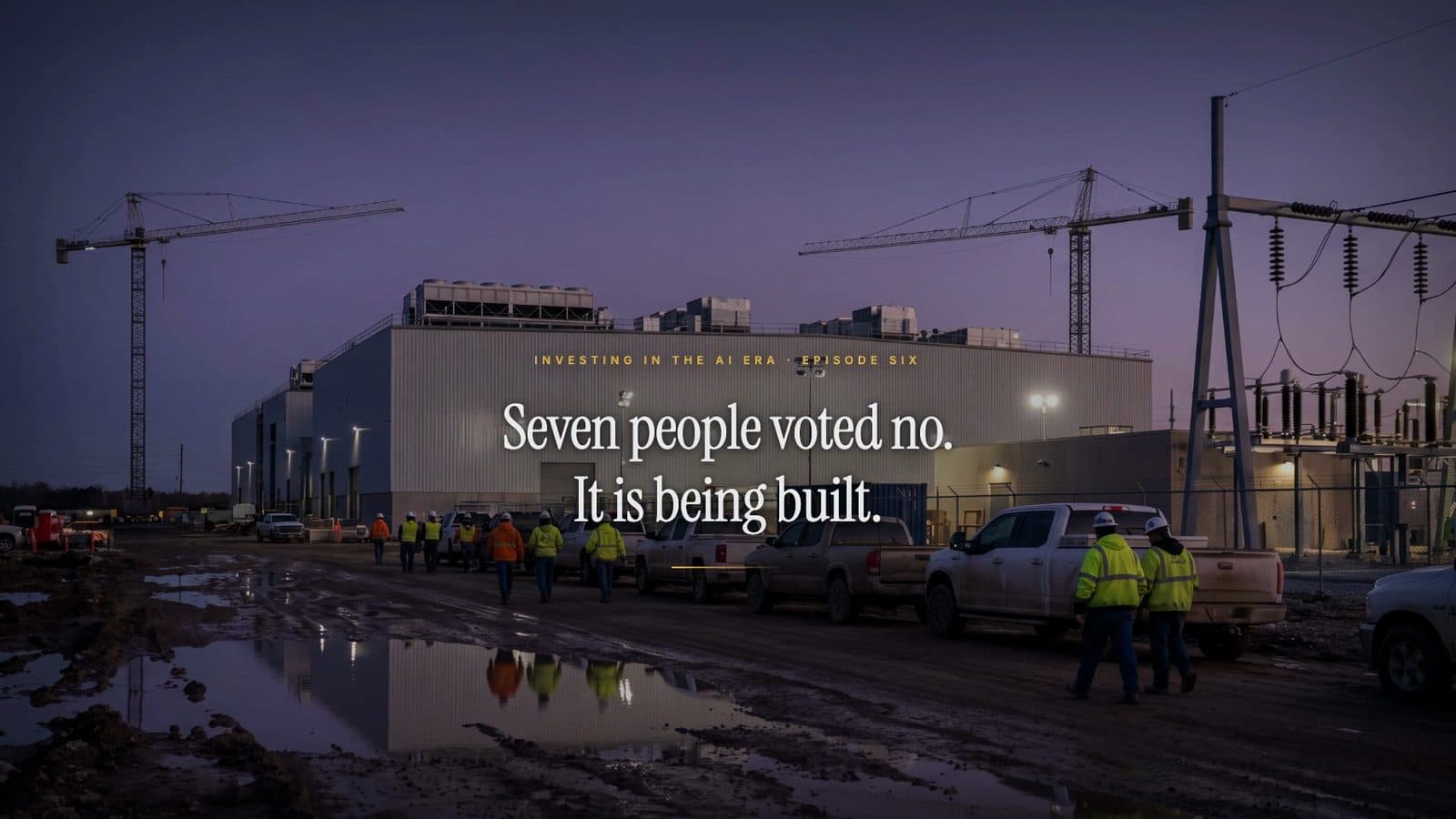
Investing in the AI Era · Episode 6
AI Eats Electricity — and Then the Grid Fights Back
"Electricity" is not one constraint.
Shares AI Infrastructure, Artificial Intelligence, Markets